There is a quiet revolution happening inside modern vehicles, and it has little to do with horsepower or battery range. Automotive designers are increasingly stepping outside the boundaries of traditional car design and looking toward architecture — with its deep concern for space, light, material, and human experience — as a primary source of creative inspiration.
The shift is not arbitrary. As vehicles become quieter, more autonomous, and more software-defined, the interior is emerging as the central battleground for brand identity and user experience. And when the driving act itself begins to recede into the background, the question of how a space feels becomes far more important than it ever was before.
From Cockpit to Living Space
For decades, car interiors were designed with a singular priority: the driver. Every element orbited the steering wheel, the instrument cluster, and the mechanical act of operating the vehicle. But that paradigm is shifting rapidly.
As advanced driver-assistance systems evolve and electric vehicles redefine the architecture of the vehicle itself — eliminating the traditional transmission tunnel, freeing up floor space, and reducing mechanical intrusion — designers are confronting an entirely new kind of brief. They are no longer designing a cockpit. They are designing a room.
This fundamental change has made architectural thinking not just relevant, but essential. Architects have spent centuries solving problems of spatial proportion, the emotional quality of light, the sensory properties of materials, and the relationship between enclosure and openness. These are precisely the challenges automotive designers now face.
Spatial Thinking and Human Scale
One of the clearest borrowings from architecture is the concept of spatial hierarchy — the idea that not all areas of a space carry equal visual or experiential weight. In architecture, this might mean the deliberate use of ceiling height to create a sense of arrival, or the careful placement of a window to frame a specific view.
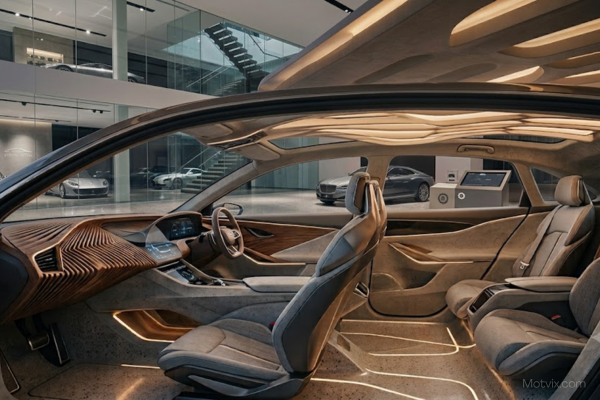
In contemporary vehicle interiors, designers are applying similar logic. Horizontal surface lines are drawn to make cabins feel wider and calmer. Recessed lighting mimics the soft, ambient illumination found in high-end hospitality design. Dashboard layouts are organized not around instrument clusters, but around a sense of visual flow — leading the eye naturally rather than demanding attention.
The concept of material honesty, long championed in modernist architecture, is also finding its way into vehicle cabins. Rather than disguising synthetic materials as something they are not, some designers are embracing the inherent qualities of their chosen surfaces — the grain of responsibly sourced wood, the weave of technical fabrics, the cool precision of brushed metal — and letting those qualities speak directly.
Light as a Design Element
Perhaps nowhere is the architectural influence more visible than in the treatment of light. Architects understand light not merely as a functional necessity but as a shaping force — something that defines mood, alters the perception of scale, and changes throughout the day in ways that make a space feel alive.
Interior vehicle designers are embracing this understanding with increasing sophistication. Ambient lighting systems are no longer simple accent strips. They are programmed to shift color temperature and intensity, to guide attention, to respond to driving mode or time of day, and to create a coherent emotional atmosphere inside the cabin.
The Broader Conversation Between Disciplines
This cross-disciplinary exchange is not entirely new — automotive and architectural design have always shared certain aesthetic conversations. But the depth and intentionality of that exchange is growing in ways that are reshaping the industry.
Major automakers are actively recruiting designers with backgrounds in interior architecture, product design, and spatial design. Collaborations between vehicle brands and architectural studios are becoming more visible, producing concepts that challenge conventional assumptions about what a car interior can be.
The result is a new generation of vehicle cabins that feel less like machines and more like considered spaces — places designed with the same care and intention one might bring to a well-crafted room.
A New Standard for the Interior Experience
As the automotive industry continues its transformation, the interior will only grow in strategic importance. Consumers are spending more time in their vehicles, expecting more from them emotionally and experientially, and making purchase decisions based increasingly on how a cabin makes them feel.
By turning to architecture — a discipline built on the idea that designed spaces profoundly affect human wellbeing — automotive designers are acknowledging something important: the car is no longer just a machine that moves people. It is a space that shapes how people feel while moving through the world.
That is a responsibility that demands exactly the kind of thinking architects have always brought to their work.