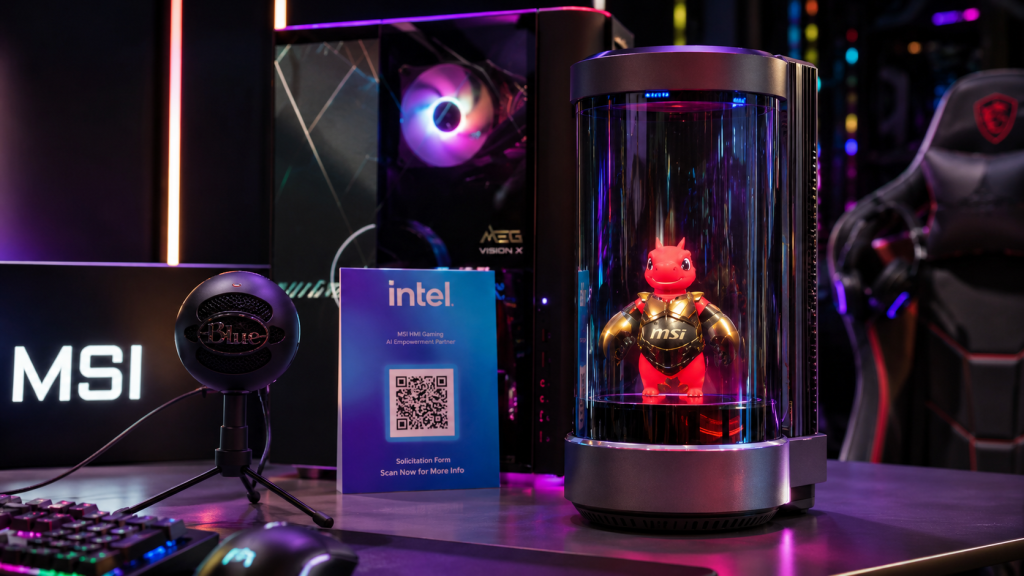
The MSI MEG Vision X2 AI+ is one of the most unusual gaming desktops shown at Computex 2026. Its main attraction is LuckyClaw, an AI companion displayed through a hologram-like module built into the PC case.
What MSI Presented
MSI introduced the MEG Vision X2 AI+ as a gaming desktop designed around a more interactive PC experience. Instead of using AI only in software, the company placed the assistant directly into the hardware design.
The system includes a cylindrical display interface called AI Holostage. This module gives LuckyClaw a visible presence on the front of the desktop. According to the information available so far, the assistant can respond to natural voice commands.
How LuckyClaw Works
LuckyClaw is designed to help users control several PC functions without opening multiple menus. It can manage performance profiles, adjust RGB lighting, and control compatible MSI monitor settings.
This approach could be useful for gamers who often switch between gaming, streaming, work, and general use. Instead of changing settings manually, the user could ask the assistant to apply a specific mode.
MSI also suggests that LuckyClaw may improve over time through future skill updates. However, the company has not confirmed the full list of features that will be available at launch.
What Is Known About the Hardware
MSI has not announced complete specifications for the MEG Vision X2 AI+ yet. Early information points to an Intel processor and an Nvidia GeForce RTX graphics card, but exact configurations remain limited at this stage.
The broader MEG Vision AI line focuses on high-end gaming performance, AI controls, advanced cooling, and premium components. Still, buyers should wait for official specifications before comparing this model directly with other flagship gaming desktops.
Official pricing has not been announced yet. MSI has also not confirmed a clear release date or market availability for the MEG Vision X2 AI+.
Why This Matters for Gaming PCs
The MEG Vision X2 AI+ shows how PC makers are trying to move beyond raw performance. For years, gaming desktops competed mainly through faster processors, stronger graphics cards, cooling systems, and design.
Now, companies are experimenting with AI as part of the daily user experience. If LuckyClaw works smoothly, it could make system controls easier for people who do not want to adjust advanced settings manually.
At the same time, the concept raises practical questions. Some users may prefer traditional controls, especially when changing performance settings. Others may see value in a hands-free assistant that simplifies common tasks.
What This Means for Users
The MSI MEG Vision X2 AI+ is not just another gaming tower with a powerful graphics card. It is a sign that gaming PCs may become more personalized, more automated, and more interactive.
For now, the most important details are still missing. Price, launch timing, final specifications, and real-world performance will decide whether this idea becomes useful or remains a striking concept.
If MSI delivers a polished experience, LuckyClaw could become one of the first examples of AI moving from the screen into the physical design of a gaming PC.