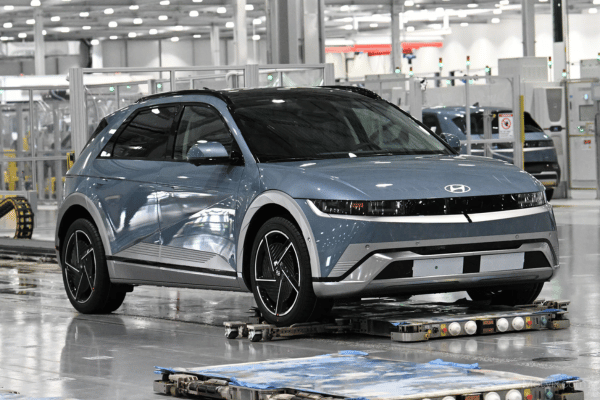
Hyundai Motor is weighing one of the most ambitious manufacturing expansion plans in the American auto industry in years. CEO José Muñoz told CNBC on Thursday that the company is actively considering growing the production capacity of its Georgia Metaplant from 500,000 vehicles annually to between 700,000 and 800,000 units by 2028 — a move that, if fully executed, would make it the single largest vehicle assembly facility in the United States.
The plans have not been formally confirmed. Hyundai clarified following the interview that the expansion is under consideration but has not been officially decided. Still, the direction is unambiguous: Hyundai wants to build significantly more vehicles in America than it does today, and it wants that capacity in place fast.
A $7.6 Billion Plant That Is Already Running
The Hyundai Motor Group Metaplant America in Ellabell, Georgia is one of the newest and most technologically advanced automobile factories in the country. The $7.6 billion Metaplant, which Hyundai first announced in 2022, is currently turning out the all-electric Ioniq 5 and Ioniq 9 models alongside the Kia Sportage hybrid. The facility is designed to build hybrid and all-electric vehicles for the Hyundai, Genesis, and Kia brands.
Under its current planned framework, the Georgia campus would employ upward of 8,500 people directly, with a further 6,900 positions supported at supplier facilities nearby. That workforce picture would grow substantially if the expansion proceeds. Muñoz said the company plans “to produce a variety of models and hire thousands of additional workers” at the site.
Why Hyundai Wants More Capacity
The driving force behind the expansion is a combination of strong sales momentum and trade policy pressure. Muñoz said President Donald Trump’s tariffs, including a 15% levy on imports from South Korea, have accelerated the company’s localization plans. “Tariffs are helping accelerate our localization plan. That’s very, very simple,” he said. “The good thing is that we had already started before tariffs were announced.”
Hyundai’s sales trajectory in the US has been impressive. Hyundai’s US market share has climbed from 8.4% in 2020 to 11.2% last year, with US sales up nearly 50% over the last six years across the Hyundai, Genesis, and Kia brands. That sustained growth has created genuine demand pressure: more vehicles being sold in the US means more vehicles need to be built in the US, especially under a tariff environment that makes importing finished cars from South Korea more expensive.
Hyundai has targeted a domestic production share of at least 80% of the vehicles it moves in the US market by 2030, compared with roughly 40% in 2024. “For that purpose, we need to add more capacity,” Muñoz said. Going from 40% to 80% domestic production in six years is an enormous logistical undertaking, and expanding the Georgia plant is the most direct path to getting there.
What an 800,000-Unit Plant Would Mean
The implications of hitting the upper end of the capacity range are significant. At 700,000 to 800,000 vehicles annually, the plant would be the largest vehicle assembly operation by capacity in the US, overtaking other facilities from companies such as Tesla and Toyota Motor.
For context, Tesla’s Gigafactory Texas in Austin has a current capacity of around 500,000 vehicles per year. Toyota’s Georgetown, Kentucky plant — historically one of the largest in the country — operates at a similar scale. An 800,000-unit Hyundai plant would leapfrog both.
That ranking matters beyond bragging rights. It signals to suppliers, logistics providers, and local governments that Hyundai is building a long-term, deeply embedded manufacturing presence in the American Southeast — not a facility that could be scaled back if trade policy shifted again.
Beyond Georgia: Trucks and BOF SUVs
The Georgia expansion is not the only manufacturing investment Hyundai is evaluating. Hyundai is also evaluating additional investment for capacity outside of the Georgia Metaplant for body-on-frame vehicles such as trucks and SUVs, though Muñoz declined to disclose further details, saying the company is “always, always assessing the opportunities we have in the market.”
Body-on-frame trucks and SUVs — the Hyundai Santa Cruz pickup, potential full-size truck entries, and rugged SUV formats — are the highest-margin segment of the US automotive market. Hyundai currently has no full-size truck in its lineup, but the brand has been studying the segment for years. Muñoz’s mention of BOF capacity investment, even without specifics, is one of the clearest signals yet that a US-built Hyundai truck or large SUV may be closer than the market has assumed.
Any such expansion would be funded through Hyundai’s existing commitments
Any such expansion would be funded through Hyundai’s already-announced $26 billion US investment commitment running through 2028. That figure encompasses vehicle assembly, battery manufacturing, steel supply chains, logistics infrastructure, and advanced manufacturing technology — a comprehensive localization effort rather than a single plant investment.
For communities near the Ellabell facility and across the broader supply chain in Georgia and neighboring states, a confirmed expansion at this scale would represent one of the most significant economic development events in the region’s history. Direct employment at the plant, supplier jobs, logistics roles, and the broader economic multiplier effect of a manufacturing hub this size would have cascading benefits.
What This Means for Buyers
For US consumers, a larger and more flexible Hyundai Georgia plant means more domestically produced vehicles available across the Hyundai, Genesis, and Kia brands — with less exposure to the supply disruptions and tariff-driven price pressures that come with importing vehicles from overseas. It also means Hyundai is positioning itself to respond quickly to demand shifts between EV, hybrid, and conventional powertrains at a single facility, giving buyers more consistent availability regardless of which technology they prefer.
The final decision on the expansion is expected within the next several months as Hyundai finalizes its production planning for the second half of this decade. If approved, construction and tooling work would need to begin in 2027 to meet the 2028 capacity target Muñoz has outlined.