Volvo is making a firm commitment to plug-in hybrid vehicles — and it is setting a standard that will fundamentally change what those vehicles are expected to do. The Swedish automaker has confirmed that its next generation of PHEVs will be built around electric ranges of up to 100 miles, combined driving ranges of 500 to 600 miles, and a driving experience designed to feel like an electric vehicle in nearly every real-world situation. Statements from Volvo’s UK head Nicole Melillo Shaw and chief strategy officer Michael Fleiss confirm this is not a concept — it is the direction the brand is actively building toward.
The Problem With PHEVs as They Exist Today
To understand why Volvo’s announcement matters, it helps to understand why most plug-in hybrids have not delivered on their promise. When a PHEV offers only 20 or 30 miles of electric range, many owners simply do not bother charging it. The car ends up being driven as a conventional gasoline vehicle, with the added weight of the battery making it heavier and less efficient than a non-hybrid alternative.
“In the past, when plug-in ranges were very low, drivers rarely charged them. Volvo has invested heavily in making sure our hybrids offer a long range so that people can use them as intended. So then it becomes a true stepping stone,” said Volvo UK boss Nicole Melillo Shaw. That is the specific problem Volvo is designing against — not just adding a bigger battery, but rethinking what a PHEV is fundamentally supposed to be.
What 100 Miles of Electric Range Actually Changes
Volvo’s chief strategy officer Michael Fleiss framed the new approach directly: the company’s next-generation plug-in hybrids would feel more like “an electric vehicle with a backup engine.” They will offer enough electric power and range to feel like EVs in the vast majority of situations, and offer the fast acceleration that EV buyers expect. Volvo’s upcoming PHEVs will have around 100 miles of EV range and 500 to 600 miles of combined range.
One hundred miles of electric range is a threshold that changes real-world behavior. The average American commutes roughly 30 to 40 miles per day — a 100-mile PHEV covers that round trip with significant margin remaining. Most daily driving, including errands and short highway trips, would happen entirely on electricity for most owners, most of the time. The combustion engine becomes what it was always supposed to be: a backup for longer journeys, not the default mode.
The XC70: First Proof of the New Strategy
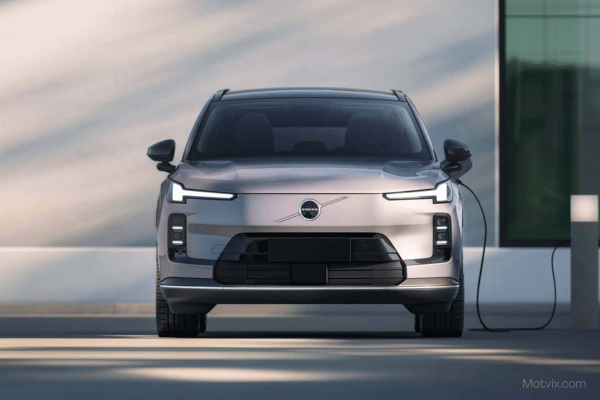
Volvo has already shown what this approach looks like in production form. The new XC70, launched in China and planned for Europe soon, is the first of Volvo’s so-called long-range PHEVs and offers a claimed engine-off range of 124 miles on China’s CLTC testing cycle — longer than any PHEV currently on sale in the UK or most European markets.
The XC70 is built on Volvo’s new Scalable Modular Architecture platform, designed specifically for extended-range plug-in hybrids. It uses a 1.5-liter turbocharged four-cylinder paired with a substantially larger battery than any previous Volvo PHEV, and is configured to prioritize electric operation in most driving scenarios.
Following the XC70, the same long-range PHEV approach will roll out across the XC60 and XC90 — Volvo’s two best-selling models globally. According to people with knowledge of the plan, the upcoming XC60 PHEV’s electric range could get near the 100-mile mark. The 2028 XC60 T8 AWD Plug-in Hybrid is slated to debut in the first half of 2027, with near-100-mile electric range achieved through a larger-capacity and more energy-dense battery pack, expected to boost the PHEV crossover’s MPGe rating by about 30%.
Why Volvo Is Not Walking Away From PHEVs
The announcement comes at a time when some automakers are pulling back from PHEVs in favor of fully electric vehicles. Volvo is taking a different position — one that acknowledges market reality without abandoning long-term electric ambitions.
While Volvo UK’s pure-electric sales have increased significantly in recent years — going from 4,556 in 2022 to nearly 18,000 in 2024 — its combustion-powered cars remain vastly more popular. Petrol has powered around 75% of the brand’s UK sales so far this year, and of those almost 7,000 were plug-in hybrids. Volvo currently offers plug-in hybrid versions of the XC60 and XC90, offering a maximum EV range of around 50 miles.
That commercial reality makes investing in longer-range PHEVs a logical strategy rather than a retreat. Volvo is not choosing between EVs and PHEVs — it is building the best possible version of both. For customers who are not ready to go fully electric, a 100-mile PHEV that genuinely behaves like an EV for daily use is a far more compelling proposition than the 35-to-50-mile options currently on sale.
What This Means for Buyers
For anyone considering a Volvo XC60 or XC90 and wondering whether to wait, the long-range PHEV update is a meaningful reason to do so. The practical difference between 35 miles and 100 miles of electric range is substantial: covering an entire week of normal commuting on electricity alone, without visiting a public charging station, becomes realistic rather than aspirational.
For the broader industry, Volvo’s commitment raises the bar for what a plug-in hybrid is expected to deliver. If buyers begin to associate 100-mile electric range with the premium PHEV standard, it creates pressure on BMW, Mercedes-Benz, Audi, and Toyota to match that capability in their own electrified offerings. That competition, ultimately, benefits every driver who wants the flexibility of a hybrid with the daily experience of an EV.