McLaren is accelerating its push into the United States. The British supercar maker’s CEO, Nick Collins, has confirmed that the brand is weighing a significant expansion of its American retail network — potentially adding up to 40% more dealerships within the next two years — as the US has emerged as the single most important market in McLaren’s global business.
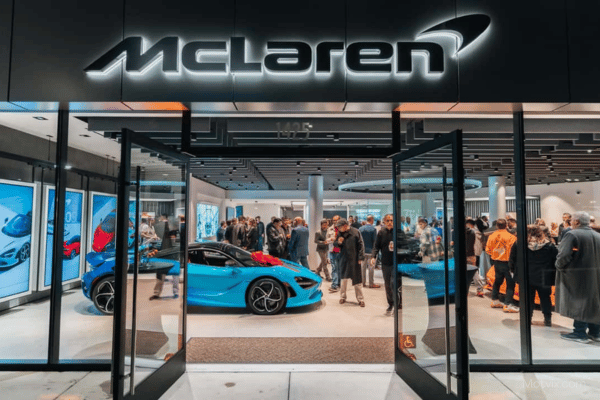
The announcement, made at a media event and reported by Automotive News on August 17, signals a meaningful shift in McLaren’s commercial strategy: from a brand that treated the US as an important export destination to one that now treats it as the core of its recovery and growth story.
America Already Owns the Numbers
The United States has grown into McLaren’s biggest single market, now accounting for more than half of its global supercar sales. For a brand that was founded and built in Woking, England, that figure is remarkable. McLaren does not publish its annual global sales numbers in the way most mainstream automakers do, but individual dealership performance is giving a clear picture of how strong demand has become.
McLaren Scottsdale, for example, reportedly sold 105 new cars and 103 certified pre-owned models last year — a volume figure that would be impressive for any low-volume exotic brand’s single location. With 27 dealerships currently operating across the US, the overall retail network is performing at a level that has the company considering meaningful expansion.
The Expansion Plan
CEO Nick Collins sees room for five to ten additional dealerships over the next two years, which would beef up the brand’s current network of 27 US stores by up to 40 percent. Prospective franchisees regularly approach the company, which Collins described as a great problem to have.
The expansion will be disciplined rather than aggressive. Collins said: “We will be higher volume than we are today, but we operate in a territory that is based around exclusivity, rather than pushing volume. We want to work with our existing partners to strengthen their footprint and presence, and we want to expand in a few places as well.”
Executives declined to name specific target markets, but industry observers expect fast-growing Sun Belt states such as Florida, Texas, Tennessee, and Nevada to capture most of the new locations. These are markets where McLaren’s core buyer profile — ultra-high-net-worth individuals who skew younger than the traditional supercar demographic — is most concentrated and fastest growing.
Experience Centers in New York, Miami, and Los Angeles
Beyond traditional dealerships, McLaren is planning a parallel investment in brand presence through a new format: corporate-run experience centers in three cities. McLaren is building corporate-run experience centers in New York, Miami, and Los Angeles, separate from standard dealerships. These high-end urban lounges focus on brand heritage, racing connections, and customer events rather than direct sales, serving as permanent hospitality spaces to engage future buyers early.
The experience center model is one that several luxury and supercar brands have adopted in recent years — Porsche, Ferrari, and Lamborghini have all built similar concepts — but it represents a new direction for McLaren. By maintaining company-owned spaces in the three largest American urban luxury markets, McLaren can engage potential buyers who may not live near a traditional dealership, exposing them to the brand long before a purchase decision.
McLaren Special Operations Front and Center
Inside both the expanded dealer network and the new experience centers, McLaren plans to push its bespoke personalization arm — McLaren Special Operations, or MSO — into a more visible role. For buyers configuring a new car, that means deeper menus of paint, trim, and one-off customization options, backed by a design team that works directly with clients.
The MSO angle is commercially important. Bespoke specification options generate significantly higher margins than standard-spec vehicles, and they deepen the emotional connection between owner and brand — making resale less likely and repeat purchases more probable. For a low-volume exotic maker where each customer relationship matters more than at a mainstream brand, that dynamic is meaningful.
New Models Fueling the Push
The retail expansion is timed around a product renewal that gives McLaren dealers genuine new inventory to sell. The forthcoming 788HS will bring greater power and more aggressive aerodynamics, while the McL 6GT concept previews a new exclusive series aimed at pushing McLaren further upmarket. Several new models are scheduled to arrive in showrooms by 2028, including the brand’s first four-door offering.
The combination of a four-door model and the expanding dealer network signals that McLaren is moving deliberately toward a slightly broader base of customers — not abandoning exclusivity, but recognizing that a brand limited to two-seat supercars can only reach so many buyers, even in its strongest market.
Formula One Is Working
One factor that McLaren’s leadership acknowledges openly is the effect of the brand’s resurgence in Formula One. After years of struggling on the racing circuit, McLaren has returned to championship contention in recent seasons, finishing third in the Constructors’ Championship in 2024 and competing near the top of the grid in 2025 and 2026. McLaren’s success in Formula 1 is unlikely to have hurt its profile, and the growing popularity of F1 in the United States has clearly helped build awareness among exactly the kind of affluent, aspirational buyer that the brand wants to attract.
The Drive to Survive effect — the Netflix series that brought Formula One to a massive new American audience — has been a measurable commercial catalyst for F1-linked automotive brands. McLaren, with its racing heritage front and center in every car it builds, is one of the direct beneficiaries. Collins wants the brand’s US market share to hold steady even as overall volumes accelerate, driven by a growing base of ultra-high-net-worth buyers and rising brand awareness fueled by Formula One’s surging popularity in America.
What This Means for Buyers
For existing McLaren owners and prospective buyers, the expansion is straightforwardly good news. More dealerships mean shorter distances to service centers — a genuine practical concern for a brand whose cars require specialized technicians and OEM parts. Experience centers in New York, Miami, and LA mean that buyers in those markets can engage with the brand without making a dedicated trip to a showroom. And a broader MSO offering means more options for the kind of personalization that supercar buyers at McLaren’s price point expect.
For the broader supercar segment, McLaren’s US expansion is a signal that demand at the top of the market remains strong even as the rest of the auto industry navigates affordability pressures, EV transitions, and macroeconomic uncertainty. Supercars sell to a buyer for whom those headwinds are largely irrelevant — and right now, that buyer is choosing McLaren in record numbers.