While the passenger car segment has embraced battery electric vehicles with growing confidence, the heavy-duty commercial trucking sector tells a different story. High payload demands, long operational ranges, and the economic weight of downtime have exposed the limitations of current battery technology at scale. Into this gap, Hyundai is moving deliberately and boldly, positioning hydrogen fuel cell powertrains as the practical answer for the freight industry’s decarbonization challenge.
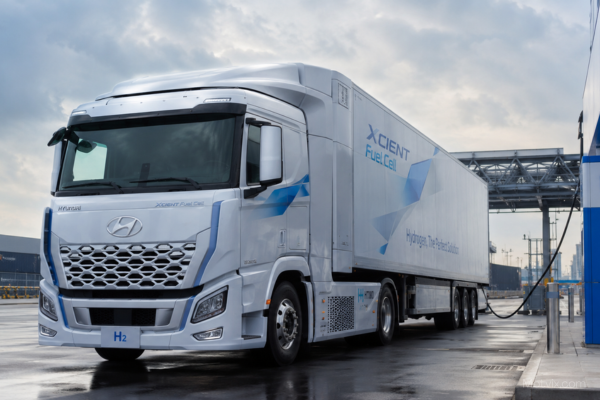
The South Korean automaker’s commitment to hydrogen is not a recent pivot — it reflects years of sustained investment in fuel cell research and real-world deployment. Yet the urgency of that commitment has sharpened as battery cost reductions in the commercial segment have slowed, leaving fleet operators searching for alternatives that can match the operational economics of diesel without sacrificing environmental credentials.
Why Battery Electric Trucks Are Struggling to Scale
Battery electric technology has delivered remarkable progress in light-duty vehicles, but commercial trucking operates under fundamentally different constraints. The energy density required to move heavy freight over long distances demands battery packs of considerable size and weight — directly eating into payload capacity and driving up the total cost of ownership.
Charging infrastructure at scale remains a significant obstacle as well. Long-haul carriers cannot afford extended downtime at charging stations, and the grid upgrades necessary to support high-power commercial charging represent a capital investment that many logistics operators are reluctant to underwrite unilaterally. The expected wave of battery cost reductions that would neutralize these concerns has arrived more slowly than industry forecasts once suggested.
This stalling has created a window of opportunity — and Hyundai intends to use it.
Hyundai’s Hydrogen Proposition for Heavy Freight
Hydrogen fuel cell vehicles convert compressed hydrogen into electricity through an electrochemical process, emitting only water vapor. For heavy-duty applications, this approach offers several structural advantages: faster refueling times comparable to diesel, a lighter energy storage solution relative to equivalent battery packs, and a range profile that aligns more naturally with long-haul logistics routes.
Hyundai has already demonstrated this technology is not theoretical. Its heavy-duty fuel cell trucks have logged meaningful commercial miles in real freight operations, providing data and operational credibility that competitors have yet to match at equivalent scale. The company continues to refine its fuel cell systems, targeting improvements in durability, efficiency, and the cost of the fuel cell stack itself — the component most responsible for keeping hydrogen trucks more expensive upfront than diesel counterparts.
The Infrastructure Challenge Remains Real
Hyundai’s hydrogen strategy is not without its own substantial obstacles. Green hydrogen — produced through renewable-powered electrolysis — remains expensive to generate and distribute. Refueling networks for commercial trucks are sparse in most markets, requiring coordinated investment from governments, energy companies, and logistics operators to reach viable density.
The automaker has been active in advocating for and participating in hydrogen infrastructure partnerships, recognizing that the technology’s commercial success depends on ecosystem development, not vehicle performance alone. Without a reliable and affordable hydrogen supply chain, even the most efficient fuel cell truck faces an uphill battle in the market.
A Long Game With High Stakes
Hyundai’s hydrogen bet in commercial transport reflects a broader conviction: that decarbonizing heavy freight will require more than one technological solution, and that hydrogen’s role in that future is not marginal but central. The company is essentially arguing that waiting for batteries to solve the heavy-duty problem is a bet on a timeline that may not materialize quickly enough for the industry’s climate commitments.
Whether that argument proves correct will depend on factors beyond any single manufacturer’s control — energy policy, infrastructure investment cycles, and the pace of green hydrogen cost reduction chief among them. But in a segment where the transition to clean power has moved more cautiously than anticipated, Hyundai’s willingness to back hydrogen with sustained investment positions it as one of the few players with a credible commercial alternative already in motion.
For fleet operators watching closely, that may be exactly the kind of commitment worth tracking.