Most lap records are planned. There are teams of engineers, timing equipment, empty circuits, fresh tires, and carefully calibrated runs across multiple sessions. What happened at Spa-Francorchamps on August 12, 2026 was none of that. A Czech hypercar called the Praga Bohema arrived at the legendary Belgian circuit for a customer track day, went out for a few sessions in traffic, on road tires, and came back with the fastest lap ever recorded at Spa by a road-legal production car.
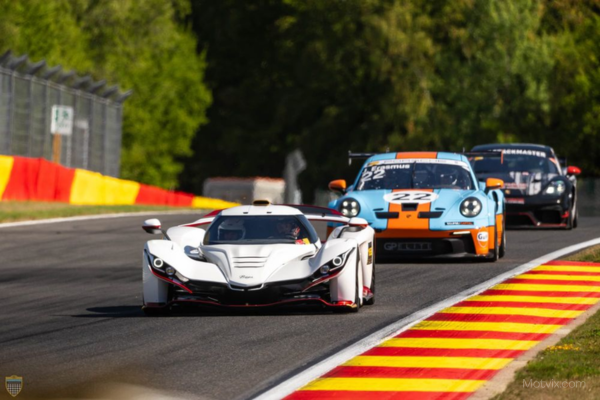
The time — 2 minutes 21.42 seconds — is more than one and a half seconds quicker than the benchmark it displaced: a 2:23.08 lap set by a Pagani Huayra BC Roadster in 2019, a record that had stood unchallenged for six years.
Who Is Praga — and What Is the Bohema?
If the name Praga is unfamiliar, that is not surprising. Praga Cars is based in Prague, Czech Republic, and is a 117-year-old manufacturer that originally built trucks, tanks, karts, motorcycles, and airplanes. In recent years it has pivoted toward ultra-exclusive, track-focused hypercars — the kind of niche, engineer-driven machines that operate far outside the world of mainstream automotive news but tend to produce extraordinary results on a circuit.
The Bohema is powered by a 3.8-liter twin-turbocharged V6 engine producing 690 horsepower. It weighs less than 1,000 kilograms — under one metric ton — which gives it a power-to-weight ratio that most supercars cannot approach. It generates 900 kilograms of downforce at 155 mph and can reach a top speed of 186 mph. Those figures put it firmly in the same conversation as purpose-built racing prototypes, not road cars. .
Praga plans to build only 89 Bohema units, with prices starting at 1.28 million euros before tax — approximately $1.4 million at current exchange rates. Customer cars are already driving on public roads and rally events instead of sitting as one-off test mules. That last detail matters: the Bohema is a type-approved, registered road car that owners can actually drive to the circuit, lap, and drive home.
A Record That Happened By Accident
The circumstances of the Spa lap are what make the story remarkable. Praga joined customers and guests at a Curbstone track day at Spa-Francorchamps, bringing a Bohema for what was intended to be a straightforward customer driving event.
Praga test driver Aleš Jirásek was behind the wheel. “We weren’t at Spa to chase a record. We were there with customers to enjoy driving one of the greatest circuits in the world. After a few sessions we realised the conditions were good and decided to see what the Bohema could do,” said Jirásek. “It’s incredible how naturally the car delivers this level of performance. We were on road tyres, there was traffic on track, and the car received no special preparation. That speaks volumes about the underlying capability of the Bohema and the engineering behind it.”
The car was running on Pirelli Trofeo R tires — road-legal rubber that ships as standard with the Bohema. Aggressive for road use, yes, but nowhere near the kind of compound a team would choose for a dedicated record attempt. The circuit was not empty. Other cars were sharing the track throughout the session.
How the Number Compares
To understand what 2:21.42 means at Spa, some context helps. The Formula 4 record at Spa is 2:22.522, the Radical Cup record is 2:22.325, and the Ferrari Challenge record is 2:19.084. The Bohema’s unplanned lap time slots in between dedicated junior single-seater racing and the Ferrari Challenge — a one-make GT series with purpose-built race cars on full race tires.
Praga calls this the lap record for a “type-approved, road-legal car on road-legal tires at Spa-Francorchamps.” So a real production road car on tires that could stay on for the drive home.
The Pagani Huayra BC Roadster that held the previous record is no ordinary car either. Powered by a Mercedes-AMG 6.0-liter twin-turbo V12, it produces around 800 horsepower and is widely regarded as one of the most capable track-oriented road cars Pagani has ever built. The Bohema beat it by 1.66 seconds — in a session that was never meant to be a record attempt.
What the Bohema Does Differently
As is so often the case with these lightweight, mega-downforce machines, it is not the Bohema’s acceleration that is breathtaking it is how little speed it needs to lose for corners. And how little time that braking takes. For a car on road tires, it is staggering.
This is the fundamental engineering philosophy behind the Bohema: rather than adding horsepower until a car is fast in a straight line, Praga has built a vehicle that is extraordinarily fast in corners because it generates extraordinary downforce at road-legal speeds. Nine hundred kilograms of downforce at 155 mph means the car effectively becomes heavier — more planted, with more grip — the faster it goes. That aerodynamic grip translates directly into corner speeds that pure-power machines cannot match without the same level of aero development.
Praga owner Tomáš Kašpárek said: “This achievement perfectly captures what the Bohema is all about. The fact that the car could set a new Spa benchmark without a dedicated record-setting programme demonstrates the natural capability of the Bohema.”
A Record That May Invite Challengers
The Spa benchmark is not as institutionalized as the Nürburgring Nordschleife lap record, which attracts years of dedicated manufacturer programs and generates enormous media coverage. But it is a respected and well-tracked reference point among hypercar enthusiasts, and displacing a Pagani from the top of that list is a statement that will not go unnoticed.
It will be interesting to watch how other manufacturers respond. Koenigsegg, Rimac, Bugatti, and McMurtry — whose Spéirling fan car holds various road car records at other circuits — all produce vehicles that could theoretically challenge the Bohema’s time with a focused effort. What none of them has done, at least yet, is set a competitive time at Spa in traffic, on road tires, without trying.
That distinction belongs, for now, to 89 cars built in Prague by a company that started by making tanks. The automotive world has taken notice.