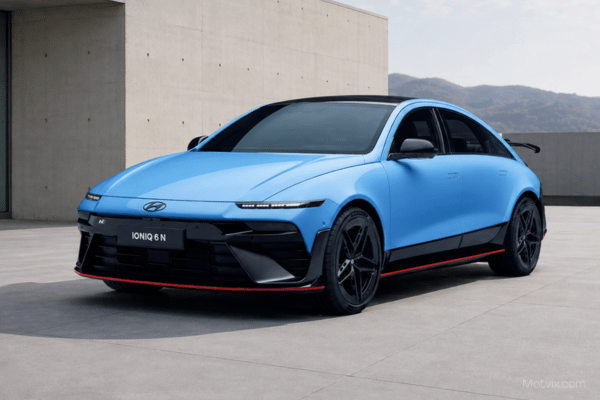
Hyundai’s performance division is about to grow in a direction that most observers did not fully anticipate. The brand’s N division — which built its reputation on front-wheel drive hot hatches and has more recently expanded into electric performance with the Ioniq 5 N and Ioniq 6 N — has now confirmed plans for a new rear-wheel drive hybrid sports car, six additional N-branded models, and a target of 100,000 annual unit sales across 40 global markets by 2030. The announcement, revealed through Hyundai’s CEO investor day presentation this week and reported today by Auto Express and Evo, marks the most ambitious expansion in N division’s fourteen-year history
A RWD Sports Car That Changes the Equation
The centerpiece of the announcement is a new rear-wheel drive performance model — a vehicle type that Hyundai N has never offered before. Every N model produced to date has used a front-wheel drive or electric all-wheel drive layout. A rear-driven car represents a fundamental shift in what N division can do.
The rear-driven model will utilize a combustion engine in a hybrid powertrain, though whether the hybridization will be mild, full, or plug-in is as yet unconfirmed. An all-wheel drive variant or sister model is also in the works. Unlike the Ioniq 5 N and Ioniq 6 N, the electric N models will continue to be the most powerful Hyundai N products overall, but the RWD hybrid is expected to be a semi-premium offering, closer in positioning to a BMW M3 than a Toyota GR86.
There is a strong possibility the new model will share more than a little DNA with future Genesis products — a detail that suggests this is not a small, affordable sports car but a more substantial and expensive vehicle that uses the performance credibility of the N badge to position itself alongside established European performance brands.
By 2030, Hyundai N aims to offer seven models in total, including an entry SUV — hinting at a successor to the Kona N — and the FR/AWD rear- and all-wheel drive model in some form. Precise timing for each new model has not been confirmed, but the investor presentation makes clear that the buildout is already underway.
A New Mid-Tier: Everyday High Performance
Beyond the RWD flagship, Hyundai has identified a gap in its performance range and is moving to fill it. The N Division will expand into new territory with a new range of variants positioned above the N Line styling packs but below the full-fat, track-ready N series — a tier described as offering “everyday high performance,” using carry-over powertrains and parts from full N cars but targeting a broader, more value-conscious buyer.
This new tier would land in the $16,000 gap between the recently discontinued i30 N Line hatch at $36,000 and an i30 N at $52,000. In practical terms, it means Hyundai wants to offer buyers a performance product with genuine N-derived hardware — not just N Line badges — at a price point that makes the driving experience accessible to a wider audience.
Models in the new tier will use powertrain and component carryover from full N cars but will prioritize daily usability and value over outright track capability. The approach mirrors what BMW has done successfully with its M Performance range, which sits between the standard lineup and the full M cars, and what Mercedes has done with its AMG 35 and 43 variants alongside its full AMG 45 and 63 models.
Traditional Hot Hatches Are Not Going Away
Despite the expansion into new territory, Hyundai has confirmed it is not abandoning the front-wheel drive hot hatch formula that made the N brand credible in the first place. Hyundai’s more traditional hot hatchback program won’t be abandoned, because the company will offer a new-generation i20 N, and an N-branded entry-level SUV is also confirmed — likely a successor to the Kona N that will appeal to buyers who want performance credentials in a compact crossover format.
Front-driven, front-engined performance models represent, according to Hyundai’s data, an 11 per cent share of the global high-performance market — a segment that cannot be ignored given the division’s lofty ambitions. With seven models across front-wheel drive, rear-wheel drive, and electric layouts, Hyundai N is positioning itself to serve virtually every corner of the performance market that matters commercially.
The Numbers Behind the Ambition
The commercial targets attached to this expansion are striking. An increase in volume to 100,000 units and an increase of market coverage from 30 percent to 60 percent across 40 global markets by 2030 is the goal for N division.
One hundred thousand N-branded vehicles per year would represent a dramatic acceleration from where the division stands today. For reference, BMW M sold roughly 180,000 vehicles globally in 2024 — a figure it took decades to reach. Hyundai N is targeting more than half that volume in under five years, which requires both new models and substantially deeper market penetration in regions where N has limited presence today.
The combination of the new mid-tier performance range — which targets a broader, more affordable buyer — and the expansion into new body types like rear-wheel drive sports cars and entry-level SUVs gives the division the product breadth to realistically pursue that volume target.
What This Means for Buyers
For drivers who currently consider BMW M, Mercedes-AMG, or Volkswagen’s GTI and R range when shopping for performance cars, Hyundai N’s expansion is significant. A rear-wheel drive N model with hybrid assistance and potential Genesis DNA, positioned against the M3 rather than the GR86, would be a genuinely new proposition in a segment where the established players have maintained near-total dominance for decades.
The mid-tier “everyday high performance” range, meanwhile, could become one of the most interesting value propositions in the performance car market — offering N-sourced hardware at a price point that many buyers currently associate with ordinary hot hatches. The full picture of what Hyundai N will look like by 2030 remains to be revealed model by model, but today’s announcement makes clear that the Korean brand’s performance ambitions are larger than almost anyone had assumed.