Tesla has placed a much clearer outline around its long-awaited European electric truck. The company’s German operation has published specifications for a Standard Range version of the Tesla Semi designed for the region, with an estimated range of 550 kilometers, energy consumption of about 1.0 kWh per kilometer and charging power of up to 800 kW.
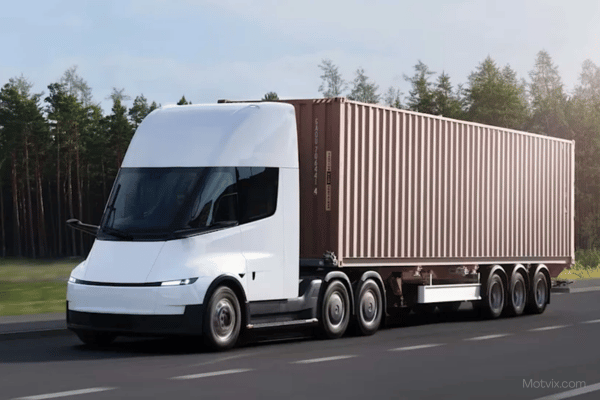
European customer deliveries are expected to begin in 2027, although Tesla has not yet explained which countries or fleets will receive the first units.
Those figures make the announcement especially relevant for regional freight, where predictable routes and scheduled depot stops can favor battery-electric trucks. The European Semi will use a 6×4 configuration and three electric motors, while Tesla says the tractor will weigh less than 9.1 metric tons.
The combination suggests that the company has focused not only on acceleration or headline range, but also on the payload economics that decide whether a heavy truck earns its place in a fleet.
What the 550-kilometer estimate means
Tesla’s range estimate is based on a 40-ton combination traveling at 80 km/h in 20-degree Celsius weather, on level ground and with an aerodynamic trailer setup.
That context matters. Real freight operations include hills, winter temperatures, wind, congestion and trailers with very different aerodynamic profiles. A responsible reading of the figure is therefore not a promise for every route, but a reference point for planners comparing vehicle types.
Even so, 550 kilometers can cover a large share of regional and national trucking assignments without requiring an oversized battery for every vehicle. Many trucks return to a home depot after a shift, while others pause at distribution centers where charging can be scheduled alongside loading, unloading or mandatory driver breaks.
A range in this class could allow operators to electrify routes that are too demanding for urban delivery trucks but do not require the maximum capacity of a long-haul model.
The reported efficiency also gives fleets a useful basis for cost modeling. At roughly 1.0 kWh per kilometer under Tesla’s stated conditions, managers can combine local electricity prices, annual mileage and expected charging losses to estimate operating expenditure. Actual results will vary, but transparent assumptions are more useful than an isolated range number.
800-kW charging changes the timetable
Charging is the other major part of the equation. Tesla says the European Semi can accept up to 800 kW of direct-current power and recover approximately 60 percent of its estimated range in 30 minutes.
In ideal conditions, that could add about 330 kilometers during a half-hour stop. The vehicle, charger, battery temperature and site connection would all need to support the advertised rate, so fleet operators should treat it as a best-case planning figure rather than a guaranteed average.
Tesla plans to support the truck with Megacharger infrastructure and says 120-kW Basechargers can serve overnight or longer depot stops. That two-level approach is sensible: extremely high power is valuable on tightly timed routes, while slower depot charging can be cheaper and easier on the local grid.
The strongest fleet projects will likely combine both, using software to reserve peak power for the trucks that genuinely need a rapid turnaround.
The company also lists an electric power take-off of 25 kW. An ePTO can operate equipment such as refrigeration units or hydraulic systems without a separate diesel engine, extending the emissions benefit beyond propulsion. For food distribution, construction and specialized transport, that detail may be as important as driving range.
Payload remains the commercial test
An electric truck cannot succeed on environmental credentials alone if its battery removes too much revenue-producing payload.
Based on the disclosed tractor weight and common European limits, specialist estimates place potential payload in a competitive range, although the final number will depend on the trailer, equipment and applicable national rules.
Tesla has not published a single universal payload claim, and operators will need certified vehicle data before making purchase decisions.
Still, the sub-9.1-ton tractor target is encouraging. European regulations can permit additional gross weight for zero-emission trucks, partly offsetting battery mass.
If the production model combines that allowance with the announced efficiency, the Semi could become relevant to high-mileage routes where fuel savings accumulate quickly. Fleet trials will be crucial because payload, charging time, driver acceptance and service availability all interact.
A broader ownership package
Tesla is also promoting remote diagnostics, over-the-air updates, service centers, workshops and a Tesla for Business platform.
Commercial customers measure downtime in missed deliveries, so software features only matter when they help keep vehicles moving. Remote fault detection can allow technicians to prepare parts before a truck arrives, while over-the-air updates may resolve selected issues without a workshop visit.
The open questions are equally important. Tesla has not announced European pricing, a detailed market-by-market delivery sequence or guaranteed infrastructure coverage.
It also has to demonstrate parts availability and service response at commercial-vehicle scale. Established truck manufacturers already have extensive support networks, and fleet buyers tend to value predictable maintenance as highly as innovation.
Why this is positive for electric freight
The most encouraging part of the announcement is that it moves the European Semi from a general ambition toward a measurable product.
Range, consumption, charging power, tractor mass and delivery timing give logistics companies parameters they can begin to test against real routes. They also intensify competition in a segment where Mercedes-Benz Trucks, Volvo Trucks, MAN, Scania and others are already expanding battery-electric offerings.
Tesla is expected to display the Semi at IAA Transportation in Hanover, giving potential customers a closer look at the regional configuration.
The decisive evidence will come later, when production trucks carry full loads through European winters and connect to busy charging sites.
For now, the 550-kilometer Standard Range model offers a credible sign that electric freight is broadening beyond city delivery and into the demanding middle ground of regional transport.