BMW has started real-world testing of the next iX5 Hydrogen near Munich as it works toward series production in 2028.
The prototypes use the company’s third-generation fuel-cell system inside the coming X5 platform, which is being engineered to support battery-electric, plug-in hybrid, gasoline, diesel and hydrogen powertrains.
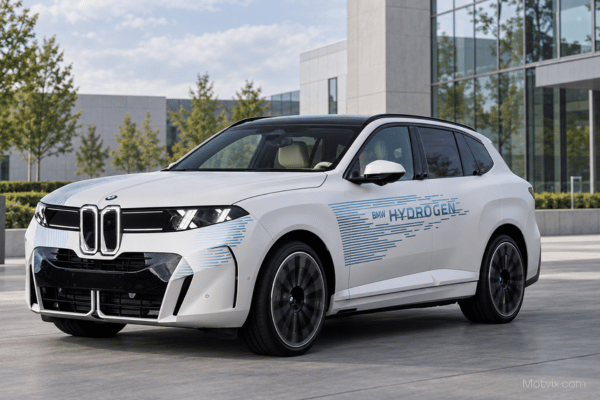
BMW says the production hydrogen model is targeting a driving range of about 750 kilometers and acceleration from zero to 100 km/h in under five seconds.
The testing phase is significant because fuel-cell vehicles have often remained limited pilots.
BMW is attempting to connect vehicle development with component industrialization: prototype systems are being assembled in Munich, production preparation is underway at its Steyr plant in Austria, and pre-series work for the Energy Master control unit is taking place in Landshut.
That does not remove the infrastructure challenge, but it shows the program is moving beyond a demonstration fleet.
How a hydrogen electric vehicle works
An iX5 Hydrogen is an electric vehicle, but it carries most of its energy as compressed hydrogen rather than in a very large battery.
Inside the fuel-cell stack, hydrogen reacts electrochemically with oxygen from the air to produce electricity. A smaller battery buffers power and recovers braking energy, while an electric motor drives the wheels.
Water vapor is the principal local exhaust product during operation.
The appeal is rapid refueling and consistent long-distance capability, particularly for drivers who cannot wait for a high-capacity battery to recharge.
The difficulty is the energy chain. Hydrogen must be produced, compressed or liquefied, transported and dispensed, and each step consumes energy.
Climate benefit depends strongly on how the hydrogen is made. Renewable hydrogen can reduce lifecycle emissions, while hydrogen produced from fossil gas without effective carbon management carries a much heavier footprint.
BMW’s technology therefore should be viewed as a complementary route, not an automatic replacement for battery-electric cars. Different regions may reach different conclusions based on electricity supply, refueling networks and industrial demand.
A third-generation system
BMW’s new fuel-cell system is designed to be more compact and efficient than the technology used in its earlier pilot fleet.
A smaller package is valuable because it gives engineers more freedom to preserve cabin and cargo space. Higher system efficiency can stretch each kilogram of hydrogen farther, reducing both fuel cost and pressure on the refueling network.
The prototype work near Aschheim allows engineers to test thermal management, control software, cold starts, noise, vibration and integration under variable traffic and weather.
A laboratory can isolate individual components, but a road vehicle must coordinate the stack, battery, motor, tanks, cooling circuits and braking system as one predictable machine.
Durability is especially important because the system has to maintain performance across years of temperature cycles.
The upcoming X5 architecture is an ambitious base for this work. Supporting five powertrain types can give BMW manufacturing flexibility and customer choice, although it also creates engineering complexity.
The first four versions are expected in 2027, with the hydrogen model planned for the following year.
From prototypes to production discipline
Series production requires much more than a successful test car.
Suppliers must deliver components at repeatable quality, assembly stations need safe procedures for high-pressure systems, and technicians require training.
BMW’s parallel work in Munich, Steyr and Landshut indicates that manufacturing questions are being addressed while the vehicle is still under development.
The German government and the state of Bavaria are supporting the HyPowerDrive program with a reported €273 million in funding.
Public investment can help close the gap between research and industrial readiness, but it also increases the need for clear results.
The strongest evidence will be a dependable vehicle, transparent efficiency data and a realistic sales-and-service network rather than a symbolic production run.
Infrastructure is the decisive obstacle
The main uncertainty is not whether a fuel-cell SUV can drive well. It is whether enough drivers will have reliable access to low-carbon hydrogen at a competitive price.
Passenger-car refueling networks remain small in many countries, and some stations have closed as operators concentrate on buses and heavy trucks.
A 750-kilometer range is useful, but only if the next station is open, compatible and supplied.
BMW has not announced final markets, price or production volume. Those details will reveal whether the iX5 Hydrogen is intended for broad retail sale or selected regions with stronger infrastructure.
Fleets, government users and customers near established hydrogen corridors could be the easiest early adopters.
The infrastructure limitation does not make the project pointless. Passenger vehicles can share parts of a broader hydrogen economy serving industry and commercial transport.
Development can also produce expertise in fuel-cell stacks, power electronics and control systems. It simply means the technology’s success will depend on an ecosystem, not on the SUV alone.
Why the program is worth watching
The positive story is BMW’s willingness to test a second zero-tailpipe-emission pathway while continuing battery-electric development.
Competition between technologies can uncover better components and give regions with different energy systems more options. It may also clarify where fuel cells genuinely add value and where batteries remain the simpler solution.
The 2028 target leaves time for the company to validate durability and for infrastructure partners to show progress.
Until certified specifications and production pricing arrive, the 750-kilometer range and sub-five-second acceleration remain development targets.
Even with that caveat, the program has reached a more serious stage: hardware is on public roads, factories are preparing and a defined production year is visible.
The next two years should reveal whether hydrogen can move from BMW’s experimental fleet into a repeatable premium SUV proposition.