Volvo has opened orders in selected European markets for a refreshed EX40 that changes much more than its front bumper.
The compact electric SUV gains new powertrain names, an official range of up to 576 kilometers, faster peak charging on the larger battery, additional driver-assistance hardware and Google Gemini integration.
Production is scheduled to begin in November 2026, with the first deliveries expected before the end of the year.
The update arrives at an important moment for the EX40. Compact electric SUVs now compete on efficiency, charging, software and safety as much as on design, and customers expect meaningful improvement between model years.
Volvo’s answer is a coordinated refresh rather than one dramatic feature. The shape remains recognizable, but the details, sensors and digital interface aim to make the vehicle feel newer and easier to live with.
Three powertrains with clearer missions
The European range begins with the P5 Electric, which uses a 70-kWh battery and a 175-kW rear motor producing 420 Nm of torque.
Volvo lists up to 477 kilometers of range, a 180-kW peak DC charging rate and a 26-minute estimate for the relevant fast-charging session. In the German market referenced at launch, pricing starts at €47,490.
The P5 Long Range steps up to an 82-kWh battery, a 185-kW rear motor and a 576-kilometer range rating. Peak DC charging rises to 205 kW, while the quoted charging time is 28 minutes.
Starting at €53,090 in Germany, this model is likely to attract drivers who regularly mix urban travel with longer motorway journeys.
At the top, the P8 Performance AWD combines two motors for 325 kW and 670 Nm. It uses the same 82-kWh battery, offers up to 538 kilometers of range and starts at €60,590 in Germany.
The slight range reduction compared with the rear-drive Long Range version is a predictable tradeoff for all-wheel-drive traction and much higher output. A heat pump is standard across the updated lineup, which can help cabin efficiency in cool weather.
Prices and specifications vary by market, and official range remains a laboratory measurement rather than a guarantee. Wheel size, temperature, speed and climate-control use can all change real consumption.
The useful point is that buyers now have three distinct choices: value and efficiency, maximum range, or higher performance with all-wheel drive.
Scandinavian restraint, sharpened
Visually, the facelift keeps the upright proportions that made the model easy to identify.
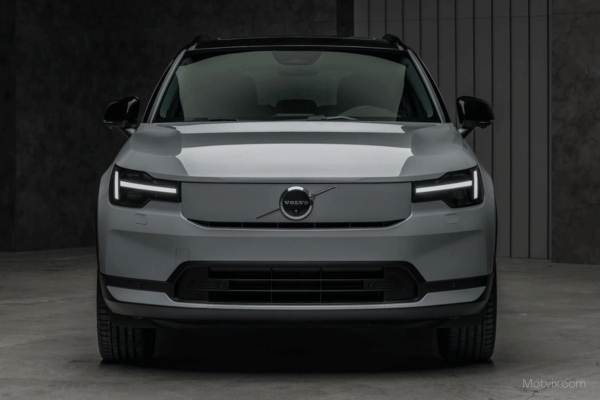
Volvo has reworked the Thor’s Hammer Matrix LED headlights, closed grille, front bumper, hood and fenders. At the rear, the lamps, tailgate and bumper receive corresponding revisions.
The result is evolutionary: the EX40 looks cleaner and more contemporary without abandoning the practical, compact shape that existing customers recognize.
That restraint is a strength. Radical redesigns can date an outgoing vehicle overnight, while subtle changes preserve brand continuity and resale familiarity.
The revised lighting signature also serves a functional role by making the vehicle more recognizable at night. For Volvo, exterior design is most effective when it communicates calm confidence rather than visual noise.
Inside, the headline is an 11.2-inch center display paired with the company’s Google-based infotainment system.
Google Gemini adds a conversational AI layer intended to handle more natural requests. In practice, the benefit should be fewer rigid command phrases when searching for a destination, controlling selected functions or asking for information.
As with any connected assistant, usefulness will depend on supported languages, data coverage and the quality of each software release.
More hardware for active safety
Volvo has expanded the EX40’s sensor set with front and corner radars, a forward camera, rear corner radars, twelve ultrasonic sensors and parking cameras.
The system supports functions including emergency steering and braking assistance, Door Opening Alert, a three-dimensional 360-degree parking view and Pilot Assist with assisted lane changes.
These systems do not turn the EX40 into a self-driving car. The driver remains responsible for supervision and control, and performance can be affected by weather, road markings or blocked sensors.
Their value lies in adding layers of support: warning about a cyclist approaching an opening door, helping maintain lane position on a long trip or offering a clearer view in a tight parking space.
The design of these aids matters as much as the feature list. Warnings must be noticeable without becoming tiring, and assistance should feel predictable.
Volvo’s reputation creates high expectations here, but independent safety testing and long-term owner experience will provide the clearest picture of how the refreshed model performs.
Software that can continue improving
Over-the-air update capability gives Volvo a route to refine infotainment and eligible vehicle functions after delivery.
That does not mean every future feature will be added to every car; hardware, regulations and market availability still set boundaries. It does mean that bug fixes and selected improvements can reach customers without a traditional service visit.
The combination of Gemini and richer sensor hardware also reflects a broader change in car design. A modern cabin is no longer finished when the physical dashboard leaves the factory.
Interface logic, voice behavior, maps and assistance software shape the daily experience throughout ownership. Automakers therefore have to design for clarity today and maintainability tomorrow.
Why the facelift matters
The refreshed EX40 is positive news because it improves several everyday attributes at once.
The Long Range version reaches a useful 576-kilometer rating, the heat pump is standard, peak charging is competitive and the safety package becomes more comprehensive.
At the same time, the exterior avoids unnecessary disruption and the software gains a more natural interaction model.
The update described here is aimed at selected European markets. Reports about the EX40’s availability in North America should be treated separately because regional product plans can differ significantly.
For European buyers, the facelift makes Volvo’s compact EV a stronger all-rounder—and shows that thoughtful design is not limited to styling. It also includes how efficiently a vehicle travels, how clearly it communicates and how calmly it helps its driver.