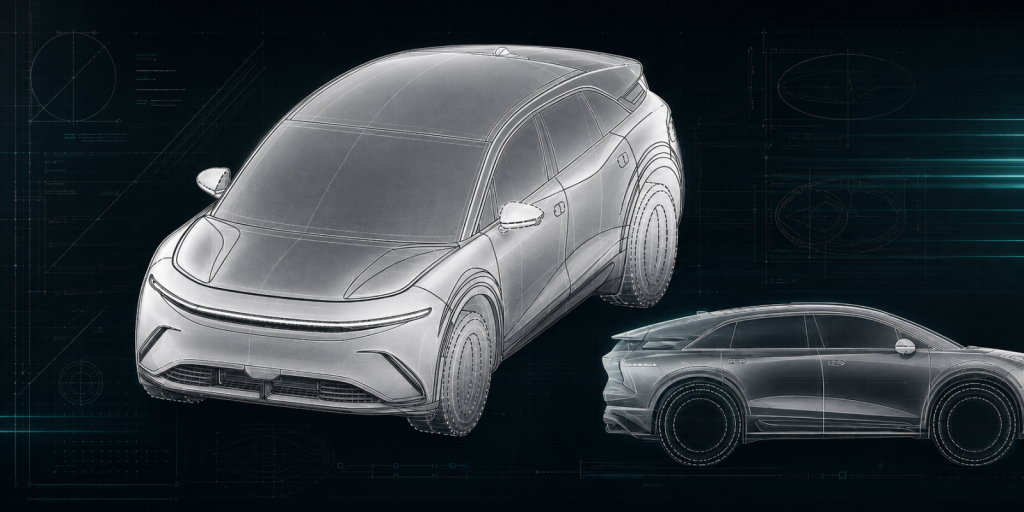
Lucid Motors has given the clearest look yet at its upcoming Cosmos midsize SUV, with patent drawings filed with the European Union Intellectual Property Office now public. The images confirm a production-ready design and reveal new details about what the brand is planning for its most accessible model to date.
What the Design Shows
The Cosmos follows the visual identity established by the Gravity flagship SUV but adapts it for a smaller, more affordable package. According to the EUIPO filings, first spotted by Electrek and AutoWeek, the front carries Lucid’s signature ultra-slim Micro Lens Array light bar — a full-width LED strip that runs across the nose and sits above a short, curved hood. An oversized Lucid emblem dominates the front, larger than anything currently found on the Air sedan or the Gravity SUV.
The side profile features a softer, more flowing character than the Gravity, with a sharply raked roofline that transitions into a dovetailed rear section. A spoiler cuts across the rear glass, and the tailgate spells out “LUCID” in large block letters above a bold bumper and diffuser. The rear taillights stretch across the full width of the vehicle. The patent drawings appear to include more than one version of the design, with some front treatments showing a more aggressive lower fascia and larger air openings, and at least one rear variant featuring pronounced corner vents — suggesting a performance-oriented trim could be in the works.
A New Platform With Practical Advantages
The Cosmos is built on Lucid’s new Midsize platform, which the company designed from the ground up to support a broader lineup at lower price points. The key component is the Atlas drive unit, which Lucid says costs 37% less to manufacture and weighs 23% less than the Zeus unit used in the Air and Gravity. It also reduces overall parts count by more than 30%, which frees up underfloor space for expanded cargo storage, a generous front trunk, and a lower rear passenger floor that improves legroom.
The electrical architecture runs on 800 volts and includes a NACS port for direct access to the Tesla Supercharger network. Based on early information, the AWD configuration is expected to reach 60 mph in approximately 3.5 seconds. Lucid has also stated the Cosmos can recover more than 200 miles of range in around 14 minutes of DC fast charging — a figure that, if confirmed in real-world conditions, would place it among the fastest-charging consumer EVs on the market. Battery capacity has not yet been officially disclosed.
Inside: One Screen, Cleaner Layout
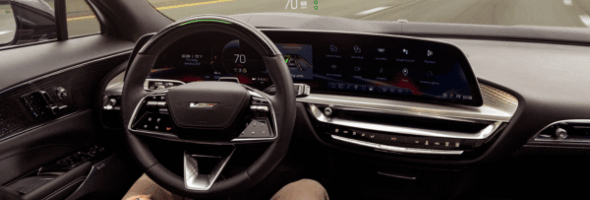
The interior moves away from the multi-screen approach found in the Air and Gravity. In its place, the Cosmos adopts a single 36-inch wide display that stretches horizontally from pillar to pillar, functioning simultaneously as the digital instrument cluster and infotainment screen. Below it sits a floating center console and dual cupholders, maintaining the minimalist character that defines Lucid’s cabin philosophy. Physical stalks for turn signals and gear selection are included — a deliberate design choice that Lucid says contributes to a more intuitive driving feel. Interior materials are described as including recycled fiber fabrics with an almost wool-like texture, stitching details, and a glass cover for the center console. A dark headliner completes the cabin.
What Could Happen Next
Lucid has confirmed a late 2026 debut for the Cosmos, with initial production planned at the brand’s manufacturing facility in Saudi Arabia. U.S. production is expected to follow approximately six to twelve months after that, based on information shared at Lucid’s Investor Day in March 2026. A starting price under $50,000 has been stated by the company, though final pricing and full specifications have not been officially released.
The Cosmos will compete directly with the Tesla Model Y, which currently starts at $41,630 in the U.S., along with emerging options such as the Rivian R2, the BMW iX3, and the Mercedes-Benz GLC Electric. For Lucid, the Cosmos represents a fundamental shift: expanding from a low-volume luxury brand into higher-volume, mainstream EV territory. Whether the combination of sub-$50,000 pricing, 800V charging, and Lucid’s efficiency advantage is enough to win buyers in that segment will become clearer once full production specifications and pricing are confirmed.