When buyers step inside a premium automobile, their attention is immediately drawn to the stitching on the steering wheel, the texture of the door panels, or the way leather wraps seamlessly around a seat bolster. These details do not happen by accident. Behind every high-end interior lies a disciplined craft that combines centuries-old techniques with modern precision engineering — and it is this combination that separates a truly premium cabin from one that merely looks the part.
In the competitive world of luxury automotive manufacturing, the interior is no longer a secondary consideration. It has become one of the most decisive factors in a buyer’s choice, and automakers know it.
Leather That Speaks Before You Touch It
The foundation of most premium upholstery programs is leather — but not all leather is created equal. The selection process for top-tier automotive hides is rigorous. Tanneries that supply leading manufacturers must meet strict standards for uniformity, softness, grain consistency, and durability. Even the origin of the hide can influence its quality, as climate and farming conditions affect the texture and strength of the material.
Once selected, leather undergoes a complex finishing process that includes dyeing, conditioning, and embossing — the latter being the technique that gives hides their characteristic grain patterns. Some manufacturers opt for a natural, open-pore finish to preserve the organic feel of the material, while others prefer a protective coating that enhances longevity without sacrificing tactile appeal.
The Precision of Every Stitch
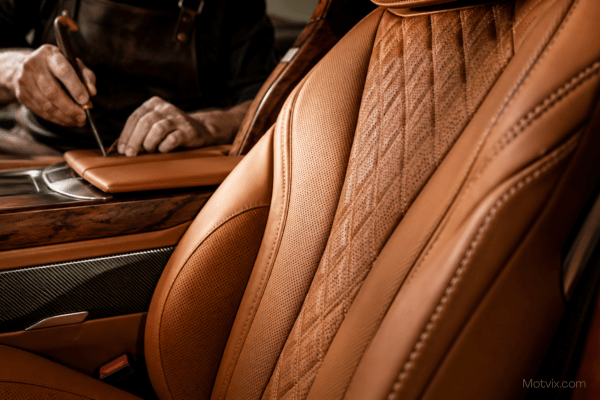
Perhaps no element communicates craftsmanship more clearly than stitching. In premium vehicles, contrast stitching — often in white, red, or copper tones — is not merely decorative. It is a structural element that holds panels together with exacting tension and follows precisely defined patterns across every surface.
Skilled artisans, sometimes working alongside computer-guided sewing machines, must ensure that stitch spacing is consistent, that thread tension does not distort the material, and that seams align perfectly across curved and three-dimensional surfaces. A single seat can require hundreds of individual stitches, and on highly bespoke builds, entire interiors may take days to complete by hand.
Diamond quilting, Alcantara overlays, and double-needle French seams are among the techniques found in the most exclusive cabins — each requiring a different set of tools and a trained eye to execute correctly.
Texture as a Design Language
Beyond leather, the modern premium interior uses texture as a deliberate design tool. Soft-touch plastics, open-pore wood veneers, brushed aluminum, and microfiber headliners all contribute to what designers call the haptic experience — the way a surface feels under the fingertips.
Automakers invest heavily in the development of new materials that offer both sensory appeal and functional durability. Sustainable alternatives such as recycled fiber composites, plant-based leathers, and bio-sourced foam padding are gaining traction, particularly as luxury brands seek to align with environmental commitments without compromising the tactile quality their customers expect.
The interplay between matte and gloss finishes, hard and soft zones, and rough and smooth textures is mapped carefully during the design phase, ensuring that every surface a driver or passenger might touch delivers a coherent and intentional sensory message.
Where Tradition Meets Technology
Modern premium upholstery is the product of a dialogue between tradition and innovation. While some of the most respected techniques date back to early coachbuilding eras, today’s manufacturers use digital pattern-cutting systems, laser-guided stitching equipment, and 3D surface modeling software to achieve a level of consistency that handwork alone cannot guarantee.
Yet the human element remains irreplaceable. Experienced craftspeople can identify tension irregularities, detect material flaws invisible to sensors, and make real-time adjustments that machines cannot replicate. This is why the world’s most prestigious automotive brands continue to invest in training programs for upholstery specialists — positions that require years of practice to master.
Details That Define the Brand
Ultimately, what makes premium car upholstery remarkable is not any single element, but the coherence of all of them together. The way a stitch pattern echoes a brand’s logo, the way a specific grain references the vehicle’s heritage, or the way a texture subtly complements the exterior color — these are the decisions that transform an interior from comfortable to genuinely memorable.
In a segment where buyers are increasingly informed and demanding, the craft behind premium upholstery is not a luxury afterthought. It is a core part of the automotive experience — one that tells a story with every seam, every surface, and every carefully placed thread.