General Motors has given one of the automotive industry’s oldest connected services a complete rethink. General Motors is adding a personal AI assistant to OnStar as part of a broader makeover of the subscription-based connected car service that the US automaker launched 30 years ago. The OnStar AI Assistant will debut in the 2027 Cadillac Lyriq EV in the coming months, with more GM vehicles to follow, the company said Wednesday at its GM Forward event in New York.
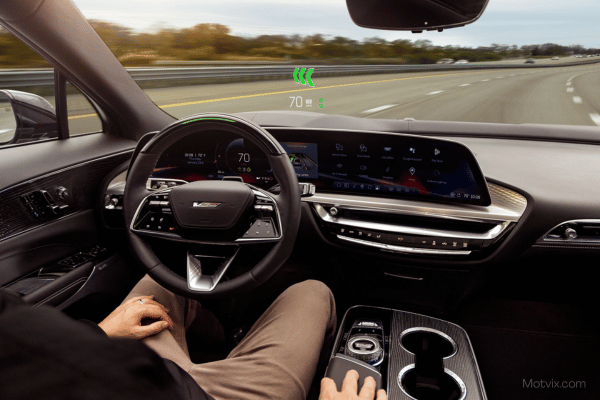
The announcement is one of the most significant in OnStar’s history — not because it adds new hardware to GM’s vehicles, but because it fundamentally changes what the service is for. For three decades, OnStar was a safety and emergency tool. Starting in 2027, it will also be the vehicle’s daily conversational interface.
From Emergency Service to Daily AI
Today, OnStar serves more than 12 million subscribers in 22 markets, and GM is rebuilding it around AI. The company announced the new OnStar AI Assistant, a chatbot it wants drivers to talk to in their vehicles every time they get behind the wheel, rather than saving OnStar for emergencies.
That shift in intent is the most important aspect of what GM announced. OnStar was designed around the assumption that most interactions would be rare and high-stakes — a crash, a breakdown, a stolen vehicle. The new OnStar AI Assistant is designed around the opposite assumption: that drivers will interact with it constantly, for low-stakes everyday tasks that previously required looking at a screen or consulting a manual.
A GM spokesperson told The AI Economy that Google Gemini powers OnStar AI Assistant, extending a partnership that dates to 2019, when GM began building Google software into its vehicles. Gemini is Google’s most advanced large language model family, the same underlying technology that powers Google’s Bard and Gemini consumer products. Its integration into OnStar gives the assistant access to both GM’s vehicle data and Google’s broader knowledge base — a combination that allows it to answer questions that span both the specific (what does this warning light mean on my specific vehicle?) and the general (what is the best route to avoid the traffic I’m currently sitting in?).
What It Can Actually Do
The capabilities GM demonstrated at the GM Forward event fall into several practical categories, each addressing a different type of driver need.
The automaker said its new AI-enabled feature can answer complex questions and adjust various vehicle features without the driver having to take their eyes off the road. The voice assistant can be activated with the “Hey, OnStar” key phrase, followed by a command.
Vehicle control is the most immediately practical feature. The system has access to vehicle data like tire pressure, charging status, and projected range, and can control features such as the dome lights, the electronic glove box, and the charge port, among others. Rather than navigating a touchscreen menu to find the charge port release while standing next to the car in a parking lot, an owner can simply say “Hey, OnStar, open the charge port.”
The new OnStar AI Assistant can plan charging stops in EVs if the driver asks something like “Do I have enough range to get there?” It can also explain what a specific error message or warning light means. The range planning feature is particularly valuable — it gives the EV-specific functionality that has historically required a separate app, integrating it directly into a voice conversation that also handles other vehicle functions.
The most ambitious application is contextual awareness. If you’re stuck in traffic on the way to pick up your child from soccer practice, the assistant could recognize that your partner’s vehicle is closer, alert them to head to the field, and reassign you to grocery pickup. That kind of multi-device, household-level coordination requires the assistant to have access to calendar data, family member device locations, and traffic data simultaneously — a level of integration that GM is clearly building toward, even if all of those features may not be available at launch.
The system can explain specific features installed on the vehicle, making the user’s manual redundant. For buyers of complex modern vehicles — where features like Super Cruise, one-pedal driving, and regenerative braking tuning are buried in menus — this alone could materially improve the ownership experience.
Natural Language, Contextual Understanding
What distinguishes the OnStar AI Assistant from previous voice assistants in GM vehicles is its conversational capability. Earlier voice systems required precise commands — “Navigate to” or “Call” followed by exact phrasing. The Gemini-powered assistant accepts natural language, including indirect phrasing.
For instance, if it’s too hot inside, the driver can say “It’s getting warm in here,” and the air conditioning system will lower the temperature. That kind of indirect request — where the system infers the desired action from a statement of condition rather than an explicit command — is the hallmark of genuinely useful conversational AI. It matches how people naturally talk, rather than requiring them to adapt their speech patterns to a rigid command syntax.
The OnStar AI can also make recommendations based on hazards it detects. Proactive hazard alerts — where the car identifies a potential problem and informs the driver before they notice it — move the assistant from reactive to predictive, a meaningful upgrade in what connected vehicle services can offer.
A New App, and a Privacy Architecture
The OnStar AI Assistant is one part of a broader set of announcements from GM’s Forward event. The company said it will launch a new OnStar mobile app in 2027 that will complement and sync up with its in-car software. The new OnStar mobile app will replace the current OnStar Guardian app that launched in 2020 as well as vehicle brand apps for Buick, Cadillac, Chevrolet, and GMC.
Consolidating four brand apps and the Guardian app into a single platform simplifies the owner experience considerably. Currently, a Cadillac owner who also uses OnStar Guardian must maintain two apps and manage notifications across both. The new unified app ends that friction.
On data privacy — always a sensitive topic for connected car services — GM was direct about the approach. A GM spokesperson shared that third-party sharing is “feature-specific and consent-based, with information shared only as needed to provide requested functionality.” Customers can manage permissions and withdraw consent, however those who choose not to share certain data may have limited access to related features, while other OnStar services would continue.
All this being said, an operator will be ready to take over when the AI assistant can’t offer a clear answer. That human backup remains part of the OnStar architecture — the AI handles the vast majority of queries, but the safety net of a human advisor for situations the AI cannot resolve stays in place.
What This Means for Drivers and the Industry
The OnStar AI Assistant’s debut in the 2027 Cadillac Lyriq is the beginning of a rollout that will eventually reach GM’s entire connected vehicle fleet. GM CEO Mary Barra said the OnStar AI Assistant is included with a driver’s OnStar subscription. For existing OnStar subscribers in eligible vehicles, that means a significant capability upgrade at no additional cost — a departure from the industry pattern of charging separately for AI features.
For the broader automotive technology industry, GM’s announcement is a data point in an accelerating competition. Stellantis is collaborating with French AI firm Mistral, Mercedes is integrating ChatGPT, and Tesla has brought xAI’s Grok to its vehicles. Every major automaker is now actively integrating a large language model into its connected vehicle experience. The differentiation will come not from whether a vehicle has an AI assistant, but from how well that assistant understands the vehicle it is embedded in — and how naturally it fits into the way drivers actually talk and think while behind the wheel.
GM’s thirty-year investment in OnStar’s data infrastructure gives the Gemini integration a meaningful head start. The assistant does not just have access to a general-purpose language model — it has access to millions of GM vehicle journeys, maintenance records, and real-time fleet data that most AI implementations cannot draw on. Whether that data advantage translates into a noticeably better experience for drivers is the question that the 2027 Cadillac Lyriq launch will begin to answer.