Few sensory experiences in the automotive world feel as quietly reassuring as the sound of a well-engineered car door closing. That firm, muted thud — neither hollow nor aggressive — signals quality before the engine even starts. Yet most drivers never stop to consider the extraordinary amount of engineering discipline hidden behind that single, fleeting moment.
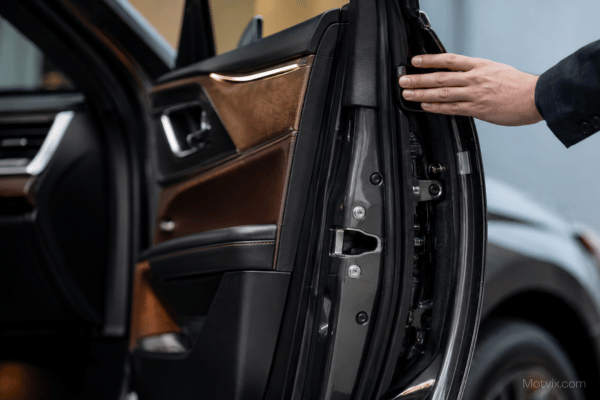
The closing sound of a car door is not an accident, a coincidence, or a lucky byproduct of good materials. It is a meticulously crafted acoustic and mechanical event, shaped by dozens of engineering decisions made long before any vehicle reaches a showroom floor.
Acoustics: Tuning the Sound Like an Instrument
Automotive engineers and acoustic specialists treat the door closing sound almost like a musical note. The goal is to achieve a tone that communicates solidity and precision without feeling harsh or heavy. This requires careful management of multiple variables simultaneously.
The materials used in the door’s inner structure — the reinforcement beams, the sound-dampening foam layers, and the sealing strips — all contribute to how sound travels and dissipates at the moment of closure. Too much resonance produces a tinny, cheap sensation. Too little creates a dull, lifeless thud that feels equally unimpressive.
To fine-tune this experience, manufacturers use acoustic simulation software during development, running thousands of virtual tests before a physical prototype is even built. Engineers analyze sound frequencies, vibration patterns, and air pressure changes to identify the precise combination that delivers the desired auditory result.
The Latch Mechanism: Small Component, Big Role
At the mechanical heart of every door closing experience is the latch — a compact but sophisticated component that determines how the door engages with the vehicle’s body. Modern door latches are precision-engineered to release and lock in a controlled sequence, absorbing kinetic energy progressively rather than abruptly.
High-end manufacturers often use multi-stage latch systems that guide the door through two or more engagement points as it closes. This progressive resistance gives the driver a sense of deliberate, controlled finality rather than a sudden impact. The geometry of the latch’s ratchet teeth, the spring tension, and the surface finish of its contact points all play measurable roles in the perceived quality of the closure.
Even the speed at which the latch mechanism resets — ready for the next opening cycle — is factored into overall door feel assessments during quality validation testing.
Seals, Gaps, and the Physics of Air
When a car door closes, it must compress multiple rubber seals simultaneously while displacing the air trapped inside the cabin. If this process is not carefully managed, the result can be unwanted pressure resistance, squeaking seals, or a booming pressure wave inside the vehicle.
Engineers design door seal profiles with specific cross-sectional shapes that compress progressively and release air at a controlled rate. The gap tolerances between the door panel and the vehicle body — typically measured in fractions of a millimeter — are equally critical. Consistent, tight panel gaps ensure that seals compress evenly, which directly affects both the sound and the tactile resistance felt by the person closing the door.
This is why vehicles with poor build quality often produce inconsistent door sounds: even minor variations in panel alignment can dramatically alter the acoustic and mechanical result.
The Human Perception Factor
Beyond the purely mechanical and acoustic elements, automotive engineers also study human psychology when designing door closing experiences. Research consistently shows that perceived vehicle quality is strongly influenced by secondary sensory cues — and the door sound ranks among the most powerful of these.
This is why brands invest in what is sometimes called psychoacoustic engineering: the deliberate shaping of sounds to align with consumer expectations and brand identity. A luxury sedan is expected to close with quiet authority. A sports car may be tuned for a slightly sharper, more athletic tone. These differences are intentional and brand-specific.
Engineering Hidden in Plain Sound
The next time you step out of a car and hear that satisfying click and thud as the door settles into place, consider the layers of expertise behind it. Acoustic engineers, mechanical designers, material scientists, and quality validation teams all contributed to that single moment. It is a small but telling reminder that in automotive engineering, no detail — however invisible — is ever truly left to chance.