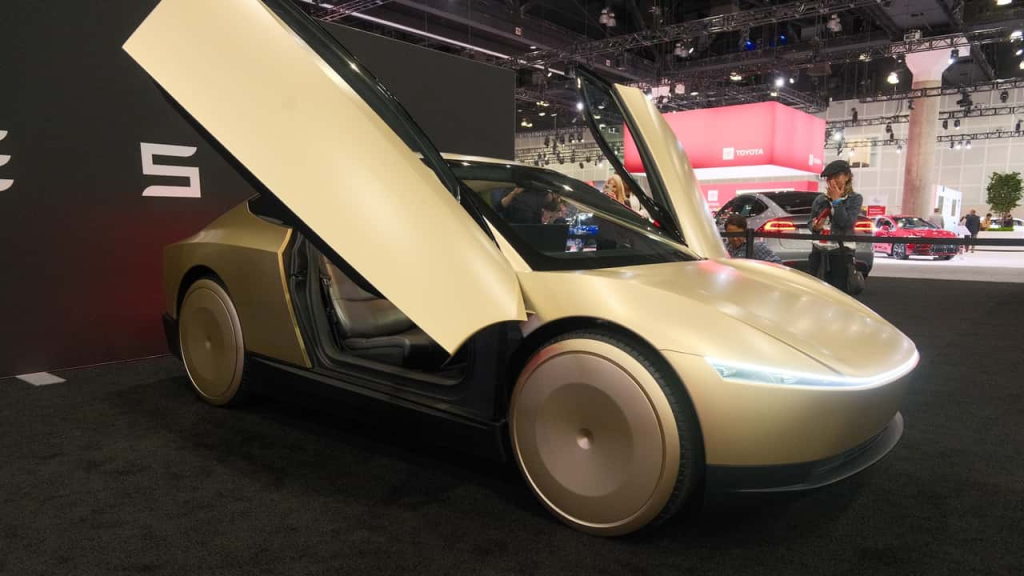
Tesla’s EPA certification documents for the Cybercab are now public, and they offer the most detailed technical picture yet of the company’s purpose-built autonomous vehicle.
What the EPA Filing Actually Reveals
The filing, first surfaced by Electrek and confirmed across multiple sources, shows that the Cybercab runs on a single lithium-ion battery pack with a capacity of approximately 48 kWh. The pack operates at 326 volts with 146 ampere-hours of capacity. That figure is notably smaller than the 57.5 kWh battery found in the standard rear-wheel-drive Model 3.
Power comes from a single front-mounted permanent magnet motor producing 163 kW, which translates to around 219 horsepower. The vehicle tips the scales at 3,113 pounds, making it the lightest production EV currently on the U.S. market. The absence of a traditional steering wheel, brake pedals, and a large battery pack all contribute to that reduced weight.
The unadjusted EPA test range comes in at 418.2 miles under combined cycle testing. However, once the EPA’s standard 0.7 correction factor for electric vehicles is applied, the estimated real-world figure drops to approximately 293 miles. That aligns with what Tesla previously communicated publicly, describing a range of “close to 300 miles.” The highway unadjusted figure sits at 375.4 miles, which is lower than the combined result — expected, since sustained highway speeds draw more energy.
Efficiency That Sets a New Standard
One of the most notable findings in the filing is the Cybercab’s energy efficiency: approximately 6 miles per kilowatt-hour. According to multiple automotive sources, that places it above every other production EV currently on the market. The result comes from a combination of aerodynamic optimization, a lightweight two-seat layout, and the absence of components typically found in conventional passenger vehicles.
The Cybercab’s primary charging method is wireless induction. The filing notes a recharge energy of 53.365 kWh from the wall to fully restore the battery — about 12 percent more than usable capacity, which reflects typical charging losses through inductive systems. This is worth noting for anyone tracking the operating economics of autonomous ride-hailing.
Tesla introduced the Cybercab into commerce on May 29, 2026 — one day after Texas Senate Bill 2807 came into effect, authorizing commercial driverless vehicle operations statewide. Production began at Giga Texas in April. The company currently operates a limited robotaxi service in Austin, Dallas, and Houston using Model Y vehicles, and the Cybercab is intended to eventually replace them as the primary fleet vehicle.
What This Means for Automotive Tech
The EPA certification is a procedural step, but it carries broader significance. It confirms that Tesla has cleared a critical regulatory milestone and is moving toward scaling its autonomous ride-hailing ambitions. The Cybercab still needs additional approvals before it can carry paying passengers without human oversight, and Tesla has not confirmed a public launch date or final pricing, though earlier communications pointed to a starting price in the range of $30,000.
For the automotive industry, the Cybercab’s efficiency numbers will draw attention. Achieving approximately 293 miles of real-world range with a 48 kWh battery — smaller than many compact EVs — raises the bar for what energy-optimized electric vehicle design can deliver. Competitors developing their own autonomous platforms will likely study this configuration closely. The next step is how quickly Tesla can ramp production and how regulators in other states and markets approach commercial driverless vehicle authorization.