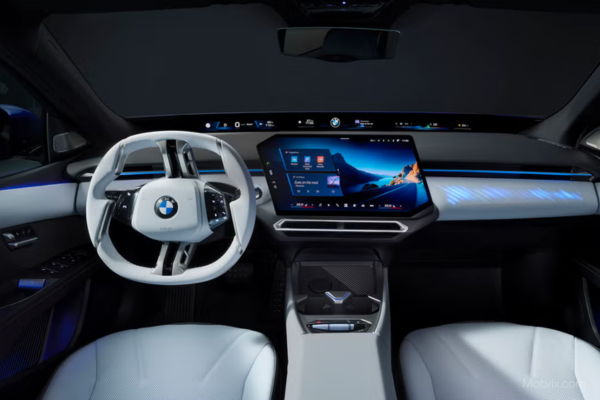
BMW has officially begun series production of the 2027 i3 sedan at its historic Munich plant, marking one of the most significant milestones in the German automaker’s transition to full electrification. The i3 is the second vehicle built on BMW’s Neue Klasse platform — the clean-sheet electric architecture that the brand says will define the next decade of its lineup — and it arrives as one of the most technically capable electric sedans on the market at its price point.
European deliveries are expected to begin in autumn 2026. US customers will have to wait a little longer, with American market models expected to arrive at dealerships in early 2027.
Not the i3 You Remember
The name i3 carries history for BMW — it was previously used on a distinctive electric hatchback sold from 2013 to 2022, a car celebrated by EV early adopters but polarizing in its appearance and limited in its range. The 2027 BMW i3 is the automaker’s take on a 3 Series EV, with a timeless design inspired by its first sedans of the 1960s and 1970s. Underneath that slightly retro styling is a thoroughly modern electric luxury sedan.
The two cars share only a name. Where the original i3 was a narrow, tall, short-range urban hatchback built with carbon fiber body panels, the new i3 is a full-size four-door sedan measuring 4,760 mm in length — closer to the current combustion-powered 3 Series in proportion — with conventional doors, a proper trunk, and performance that comfortably outpaces the car it conceptually replaces.
The Technical Specification
The launch-edition i3 50 xDrive features a 108.7 kWh battery, 463 hp, and up to 912 km of WLTP range. Built on an 800V Neue Klasse architecture, the i3 supports peak DC fast charging up to 400 kW. The EPA-estimated range for the US market is approximately 440 miles — a figure that, if confirmed, would make the i3 one of the longest-range electric sedans available anywhere in the world.
The i3 50 xDrive variant features dual-motor all-wheel drive producing 345 kW of power and 645 Nm of torque. BMW has not yet published 0-60 mph times for the production model, but given the output and the platform’s characteristics, figures in the low-three-second range are expected.
The 400 kW DC fast charging rate is particularly notable. At that level, the i3 can add significant range in just a few minutes — BMW cited similar figures for the iX3 SUV, where 10 minutes of charging yields up to 175 miles of range. If the i3 delivers comparable efficiency, it would meaningfully shorten long-distance travel stops compared with most current electric vehicles.
Munich Goes Electric-Only
The start of i3 production is not just a product launch — it is also a turning point for the factory building it. From 2027, the BMW Group Plant Munich will produce battery-electric vehicles exclusively. Its first Neue Klasse products are the i3 Sedan and Touring.
No fewer than 650 million euros will be invested for this purpose, and BMW further expects to reduce overall production costs by 10 percent through the transition. That cost reduction target matters: one of the persistent criticisms of premium EV programs has been that the economics of building electric vehicles at scale remain difficult. BMW is betting that its dedicated Neue Klasse lines — optimized specifically for EV assembly rather than adapted from combustion infrastructure — will demonstrate a different cost curve.
The Munich plant is one of BMW’s oldest and most storied facilities. Converting it to EV-only production is a statement of intent that goes beyond the i3 itself: it signals that BMW is not hedging on electrification at the center of its operations, even as some competitors pull back on EV commitments in response to slower-than-expected demand.
What’s Coming to the US
US market models are scheduled to start assembly support from BMW’s San Luis Potosí plant in Mexico later in 2026, which ensures eligibility for regional EV tax credits under updated US manufacturing rules. American customers can expect the official dealership arrival and initial customer deliveries in early 2027.
At launch, the primary variant available will be the i3 50 xDrive. A more affordable single-motor i3 40 eDrive is expected to follow later, giving buyers a lower entry point. Considering the similarly powerful BMW iX3 is anticipated to start at around $60,000 when it arrives in US showrooms, the i3 sedan will likely be priced at around $58,000 or so — only marginally more expensive than the Tesla Model 3 Performance, despite offering much more range.
What This Means for the Segment
The i3 enters a segment — premium electric sedans — where Tesla’s Model 3 has dominated without a serious European challenger at its price point. The Polestar 2, Genesis G80 EV, and BMW’s own i4 have each competed, but none has matched the Model 3’s combination of range, performance, and value. The 2027 i3 is a more direct answer: more range, faster charging, newer technology, and a starting price designed to stay competitive.
It has been fifty years since the BMW 3 Series cemented itself as the definitive sport sedan. With the reveal of the 2027 BMW i3, the iconic nameplate officially enters its electric future. Whether it can reclaim that benchmark status in an EV world is a question the first US deliveries will begin to answer in early 2027.