Production cars have been designed for speed, for beauty, for aerodynamic efficiency, for luxury, and for off-road capability. The Tesla Roadster Rocket has been designed for something none of them attempted: flight. When Tesla revealed its next-generation Roadster on October 15 in Waco, Texas, the Rocket configuration was the moment that separated the event from every other car reveal in recent memory. Musk showed off the car with a demonstration that saw it use a mixture of high-powered fans and thrusters to drive up an inverted ramp, spin around, and ease itself to a landing on the pavement below. The car also used the thrusters to lift itself over a Cybercab, Cybertruck, Tesla Semi, Model Y, and Model 3 while in motion.
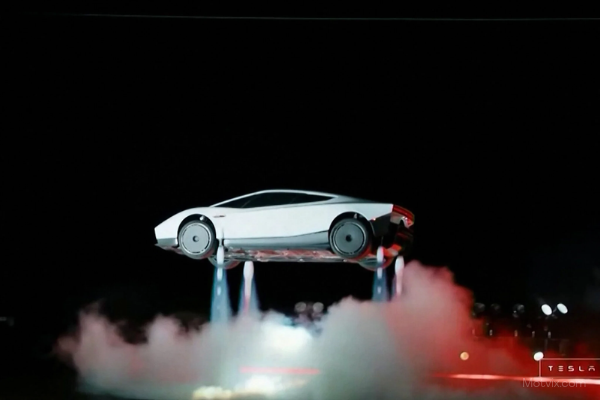
The question is not whether it is practical. The question is what design decisions were required to make it possible — and what they mean for the car as an object.
Built Around Compressed Air
The thrusters use compressed air rather than rocket fuel, with two ultra-high-pressure tanks with a combined volume of 600 liters holding about 250 kilograms of air, released through 10 nozzles, with all-electric actuators making micro adjustments to stabilize the car in flight.
Six hundred liters of compressed air storage is an enormous volume to integrate into a road car. Tesla filled every usable structural void in the Roadster’s chassis with Carbon Fiber Overwrapped Pressure Vessels — cylindrical tanks that are also structural elements, contributing to the car’s rigidity while storing the propellant for the thruster system. The result is a chassis that is simultaneously a pressure vessel farm and a supercar monocoque — a combination of aerospace and automotive engineering that has no precedent in a road-legal production vehicle.
The 10 thruster nozzles are positioned around the car’s perimeter — front, rear, and sides — in specific locations that allow the flight control system to generate force in multiple directions simultaneously. Forward thrust supplements the electric motors. Upward thrust generates lift. Combined activation of nozzles in specific sequences allows the car to rotate around a vertical axis — the spin visible in the Waco demonstration. All-electric actuators adjust each nozzle’s output in milliseconds to maintain stability during flight maneuvers, drawing on software logic developed at SpaceX for controlling multiple thrusters simultaneously.
The Suction System: Driving on Walls
A multi-mode fan and ground sealing system pulls air from under the car, producing enough suction to hold it upside down even when stationary.
The inverted ramp portion of the Waco demonstration — where the Roadster drove up a curved surface until it was completely upside down, then launched off the top — required this suction system to generate more downforce than gravity. At zero speed, with the car stationary and inverted, the fans under the vehicle had to create a pressure differential large enough to hold the car’s mass against the ramp surface. In aerodynamic terms, a moving car generates downforce through airflow over and under its body. At rest, that mechanism does not work. The active suction system replaces aerodynamic downforce with a mechanical vacuum.
The design implication is a flat underbody — one that can be sealed against the road surface to allow the suction system to function — covering a chassis that also contains 600 liters of pressurized air tanks, a high-capacity battery pack, an electric drive system, and all the mechanical and electrical systems a road-legal vehicle requires. Packaging all of that within the visual envelope of a low sports car is a design achievement of considerable difficulty.
Steer-by-Wire and a Yoke
The Roadster features steer-by-wire with a yoke-style steering control. Steer-by-wire eliminates the physical mechanical connection between the steering input and the wheels, replacing it with sensors, actuators, and software. In a vehicle with a flight control system, steer-by-wire is effectively required — the vehicle control architecture already governs multiple thrust vectors simultaneously, and integrating steering control into that system is more coherent than maintaining a traditional mechanical column alongside it.
The yoke continues the design language Tesla introduced with the Model S Plaid. In the Roadster, the absence of a traditional circular wheel also removes the visual element most associated with conventional driving, reinforcing the car’s character as something that is as much a flight system as a road vehicle.
Invite-Only: The Most Exclusive Configuration in Tesla History
The Rocket is invitation-only, not approved for public roads and not offered in every region. The Rocket’s flight capability is not certified for public road use. It operates in controlled environments — potentially the private track Tesla is planning at its Texas headquarters — rather than on public highways. This is not a car that owners will use to commute. It is a demonstration of what is possible when the constraints of road-legal production are relaxed, built for a handful of buyers who will experience it in curated circumstances.
As a design object, the Tesla Roadster Rocket is the most radical thing a mainstream automaker has produced since cars became cars. Whether it is useful is beside the point. Its purpose is to show where the boundary of automotive possibility currently sits — and then push through it.