Saudi Arabia’s emerging automotive industry has reached an important milestone with the official unveiling of the CEER EXOBOT, a new family of electric vehicles that initially includes a premium sedan and a large SUV.
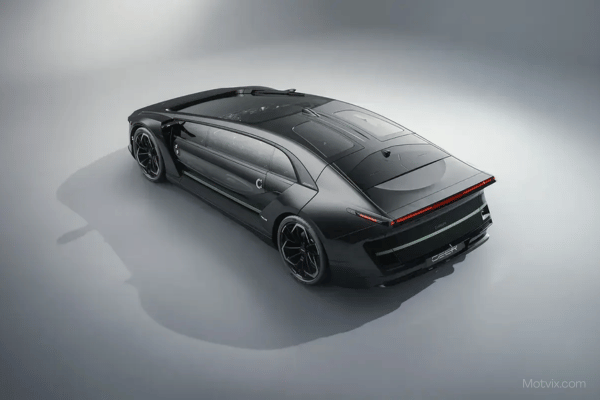
Presented in Riyadh on September 21, 2026, the two vehicles are the first production-bound models revealed by CEER, the Saudi automotive company created by the Public Investment Fund in partnership with Foxconn. They also offer the clearest indication yet of how CEER plans to compete with established manufacturers in the international electric vehicle market.
Rather than beginning with a small urban car, CEER has selected two ambitious flagship products. Both EXOBOT models feature an 800-volt electrical platform, a 112-kWh battery, three electric motors and outputs of up to 850 horsepower.
The sedan offers an advertised driving range of as much as 670 kilometers, while the SUV can cover up to 560 kilometers. Both figures were calculated under the NEDC testing cycle, so real-world results and figures under newer testing standards such as WLTP may be different.
Even with that qualification, the specifications position the EXOBOT as one of the most interesting new electric vehicle projects to emerge from the Middle East.
A design identity inspired by Saudi Arabia
CEER says the EXOBOT was designed, engineered and will be manufactured in Saudi Arabia. Its styling was inspired by the country’s landscape, architecture and cultural identity, resulting in two vehicles that avoid simply copying the visual language of an existing European or Asian brand.
Both models have a futuristic silhouette, dramatic lighting elements and an unusually clean exterior. One of the most distinctive details is the absence of a conventional center pillar between the doors.
The doors open upward, creating a large and unobstructed entrance to the cabin. The solution gives the EXOBOT the dramatic appearance normally associated with a concept car, although CEER says high-strength structural materials will help the production vehicles maintain the necessary body rigidity.
The EXOBOT sedan measures 5,260 millimeters long and has a 3,200-mm wheelbase. Those dimensions place it in the territory of large luxury sedans, giving the designers considerable space for both passengers and batteries.
Its low 1,428-mm height and long wheelbase produce an aerodynamic, almost lounge-like profile. Standard ground clearance is listed at 155 mm, increasing to 165 mm through the active air suspension.
The SUV shares the same 3,200-mm wheelbase but has a shorter overall length of 5,016 mm. Its body is substantially taller, while ground clearance can reach 300 mm with the adaptive suspension raised.
Cargo capacity is listed at 402 liters, providing useful everyday practicality without abandoning the vehicle’s premium positioning.
Tri-motor performance and an 800-volt platform
Under the bodywork, the sedan and SUV employ a common electric architecture. A tri-motor all-wheel-drive system produces up to 850 hp, allowing the sedan to accelerate from zero to 100 km/h in a claimed 2.6 seconds.
The larger EXOBOT SUV completes the same acceleration run in 2.9 seconds. Those figures place both vehicles firmly in high-performance EV territory.
A 112-kWh nickel-cobalt-manganese battery supplies energy to the three motors. The 800-volt system is designed to support rapid DC charging, with CEER estimating that the battery can be charged from 10% to 80% in less than 30 minutes under suitable conditions.
Charging performance will ultimately depend on the charging station, battery temperature and local conditions. Nevertheless, the combination of a large battery and an 800-volt platform should make the vehicles more practical on long journeys.
Both versions also receive adaptive dual-chamber air suspension and rear-wheel steering. In the SUV, the rear wheels can turn by as much as 6.5 degrees, helping reduce the turning circle at low speed and improving stability during faster changes of direction.
The SUV will additionally offer multiple driving modes and steer-by-wire technology. Instead of relying exclusively on a traditional mechanical connection, steer-by-wire electronically communicates the driver’s inputs to the steering system.
A 48-inch digital dashboard
The interior is dominated by what CEER calls the Digital Horizon: a curved, pillar-to-pillar display measuring 48 inches. The screen has an 8K resolution and can present driving information, entertainment and navigation across the width of the cabin.
A three-dimensional navigation interface, an Arabic and English voice assistant and camera-based exterior mirrors further emphasize the vehicles’ technological focus.
The EXOBOT will also connect to a dedicated CEER mobile application. Owners will be able to check battery and charging information, precondition the cabin, locate the vehicle and access service-related functions remotely.
The announced driver-assistance package includes lane centering, lane-keeping assistance, automated lane changes, collision-prevention functions and emergency assistance. An automatic emergency calling system and multiple airbags are also included in CEER’s preliminary safety description.
Final specifications may differ according to market and trim level, so consumers should wait for homologation information and independent safety testing before directly comparing the EXOBOT with established rivals.
More than a pair of new electric cars
The EXOBOT project is significant because it forms part of a much larger Saudi industrial strategy.
CEER plans to build the vehicles at its CEER Manufacturing Complex, which the Public Investment Fund describes as the largest automobile production facility in the Middle East. The company intends to introduce seven models over the next five years, including midsize and compact vehicles.
Although CEER began as an electric vehicle manufacturer, its future lineup is expected to include different propulsion technologies. Reuters reports that the product plan will eventually cover battery-electric vehicles, plug-in hybrids and internal-combustion alternatives.
The company’s supplier network is also beginning to establish a presence in Saudi Arabia. International component manufacturers including Lear, Benteler and Shin Young have been associated with local production for the project.
Foxconn is contributing electrical architecture, while BMW has provided access to component technology and engineering support. This combination gives CEER a faster route to market than developing every system independently.
The Public Investment Fund projects that CEER could contribute approximately $8 billion to Saudi Arabia’s gross domestic product by 2034, improve the country’s trade balance and support new employment. These numbers remain long-term projections rather than guaranteed outcomes, but they demonstrate the scale of the investment behind the company.
When will the CEER EXOBOT go on sale?
CEER has not released complete pricing information. Reuters reports that sales in Saudi Arabia are expected to begin in early 2027, followed by expansion into additional regional markets from 2028.
The manufacturer has already outlined First Edition versions of the EXOBOT sedan. Planned features include special exterior colors, a black appearance package, red brake calipers, Nappa leather and switchable-tint lower door panels.
The First Edition package is also expected to include home wall-charger installation, a six-year warranty, roadside assistance and scheduled service coverage. Market-specific conditions will likely be announced closer to the sales date.
For now, the most encouraging aspect of the EXOBOT is that it represents a complete industrial project rather than a single show car. Manufacturing facilities, suppliers and a broader model roadmap are already part of the plan.
Its unconventional doors, immense digital display and powerful electric drivetrain will attract attention, but the more important story is the arrival of a new automotive manufacturer with international ambitions.
If CEER can deliver the announced performance, quality and charging capabilities in a competitive production vehicle, the EXOBOT could give Saudi Arabia a meaningful place in the next phase of the global automobile industry.