Nissan has officially introduced the new Tekton in South Africa, giving the Japanese manufacturer a fresh compact SUV with a competitive starting price, practical interior and a generous selection of safety equipment.
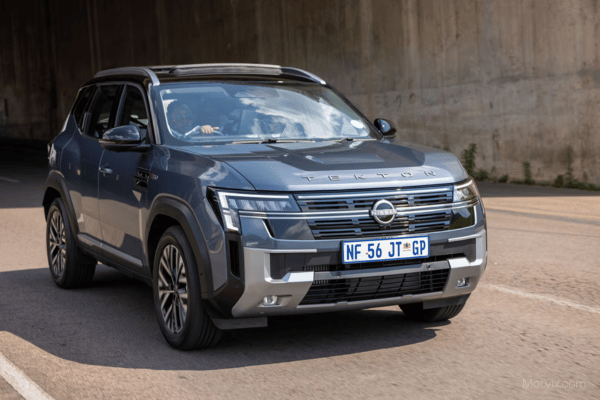
The Nissan Tekton starts at R339,999 and is available with a choice of two turbocharged gasoline engines. Every version includes six airbags, a reversing camera, a 10.1-inch infotainment screen and more than 40 standard safety-related features.
South Africa is the first African country to receive the model and one of its earliest markets worldwide. The launch therefore carries additional importance for Nissan as the company reorganizes its regional operations and prepares a broader product offensive.
Manufactured in India, the Tekton combines the size and efficiency expected from a compact crossover with styling influenced by Nissan’s much larger Patrol SUV.
Patrol-inspired styling in a smaller package
Nissan has given the Tekton an upright front end, pronounced wheel arches and a wide grille intended to create a strong visual connection with the Patrol.
The result is a compact SUV that appears larger and more substantial than its dimensions might suggest. The Tekton measures 4,349 mm long, 1,815 mm wide without its mirrors and up to 1,674 mm tall when equipped with roof rails.
A 2,673-mm wheelbase provides the foundation for a five-seat interior. Ground clearance is a useful 212 mm across the range, which should help drivers on unpaved roads, damaged urban surfaces and steep entrances.
All Tekton versions sold in South Africa use front-wheel drive. It is therefore not intended to replace a dedicated off-road vehicle, but the elevated ride height and compact dimensions should make it suitable for a wide variety of daily conditions.
Entry versions receive 17-inch steel wheels, while better-equipped models add 18-inch alloy wheels and more exterior decoration. Selected trims also offer a contrasting roof, an electric tailgate and a panoramic opening sunroof.
Two turbocharged engine choices
The most affordable Nissan Tekton is powered by a 1.0-liter three-cylinder turbocharged gasoline engine. It develops 74 kW, equivalent to approximately 99 hp, and 160 Nm of torque.
This engine is paired with a six-speed manual transmission. Nissan lists a zero-to-100-km/h time of 12.46 seconds, a maximum speed of 170 km/h and combined fuel consumption of 5.9 liters per 100 kilometers.
Those numbers suggest that the 1.0T model is configured primarily for affordability and efficiency rather than high performance. It could be particularly attractive to commuters and small families seeking SUV practicality without the fuel consumption of a larger engine.
Higher specifications use a 1.3-liter four-cylinder turbo engine producing 115 kW, or approximately 154 hp, and 260 Nm of torque.
The 1.3T is connected to a six-speed wet-clutch automatic transmission with an electronic gear selector. Nissan claims acceleration from zero to 100 km/h in 9.89 seconds and a top speed of 198 km/h.
Official combined consumption is 6.3 liters per 100 km, while estimated carbon dioxide emissions are 149 grams per kilometer. The more powerful models can tow up to 750 kg without trailer brakes or 800 kg with a braked trailer.
Neither powertrain is electrified, but both employ turbocharging to produce useful torque from relatively small engine capacities.
A practical cabin for everyday use
One of the Tekton’s strongest characteristics is its cargo capacity. The luggage compartment holds 518 liters with the second row in place.
Folding the rear seats increases available capacity to 1,789 liters. That is a substantial figure for a vehicle of this length and should make the Tekton useful for family travel, sports equipment or occasional transportation of larger items.
The cabin’s technology is centered around a 10.1-inch touchscreen. Wireless Android Auto and Apple CarPlay are available, allowing drivers to connect a compatible phone without keeping it attached to a cable.
Depending on the trim, the Tekton can also be fitted with a 10.25-inch digital instrument display, wireless phone charging, ambient lighting, automatic climate control and six speakers.
The higher Tekna Plus version adds a power-adjustable driver’s seat with lumbar support, refrigerated storage and an electric tailgate. An electronic parking brake and intelligent cruise control are also included on selected automatic versions.
Nissan has maintained physical controls for several frequently used functions, an approach that can be easier to operate while driving than placing every adjustment inside the touchscreen.
Six airbags are standard
Safety equipment is often reduced on the least expensive versions of a new vehicle, but Nissan has made six airbags standard throughout the Tekton lineup.
The body uses a monocoque structure made with 62% high-strength steel. Standard assistance systems include electronic brake-force distribution, emergency braking assistance, hill-start assistance and hill-descent control.
ISOFIX child-seat mounting points, parking sensors and a rear camera are also included. More expensive versions expand the package with a multi-view camera, blind-spot warning, lane-departure warning, lane-keeping assistance and forward-collision warning.
Equipment availability still varies by trim, making it important for buyers to compare the exact safety specification rather than assuming every driver-assistance feature is included on the base model.
Nevertheless, the presence of six airbags and more than 40 standard safety features gives the entry-level Tekton a credible foundation.
A significant launch for Nissan South Africa
The Tekton arrives during a period of transition for Nissan in South Africa. The company sold its Rosslyn manufacturing facility near Pretoria to Chery and has shifted toward a business centered on imported vehicles.
That change raised questions about Nissan’s future in the country, but the manufacturer says it remains committed to the South African market.
The Tekton is part of a planned series of new products intended to rebuild momentum. Nissan has also introduced the latest X-Trail and plans to bring an updated Navara and the eighth-generation Patrol to South Africa during its current financial year.
This means the brand will cover several important market segments, ranging from an accessible compact crossover to a pickup and a full-size premium SUV.
For Tekton buyers, Nissan provides a six-year or 150,000-km mechanical warranty. The vehicle also includes a four-year or 60,000-km service plan, with maintenance intervals set at 15,000 km or 12 months.
The combination of warranty coverage, standard safety equipment and a R339,999 entry price should help Nissan compete in a segment filled with products from established Japanese, Korean, Indian and rapidly expanding Chinese brands.
A promising new option in a crowded segment
The compact SUV category has become one of the most competitive areas of the South African automobile market. Buyers expect useful ground clearance, modern connectivity and family-friendly space without the purchase price or fuel consumption of a larger SUV.
The Nissan Tekton has been developed around exactly those priorities.
The base 1.0T manual keeps the advertised price accessible, while the stronger 1.3T automatic offers more relaxed performance for highway driving. Cargo volume is generous, and the inclusion of six airbags across the range is a meaningful advantage.
Its front-wheel-drive configuration means it should be considered an urban and touring crossover rather than a serious off-road vehicle. Even so, 212 mm of ground clearance gives it more flexibility than a conventional hatchback.
Most importantly for Nissan, the Tekton provides a visible demonstration that the company’s product activity in South Africa is continuing despite the end of local manufacturing.
If the vehicle delivers good real-world fuel economy and competitive ownership costs, it could become an important volume model for the brand and a practical new choice for South African families.