BYD’s premium Denza brand has officially launched the new Z9S electric sedan in China, introducing an unusually broad combination of long-range efficiency, rapid charging and high-performance technology.
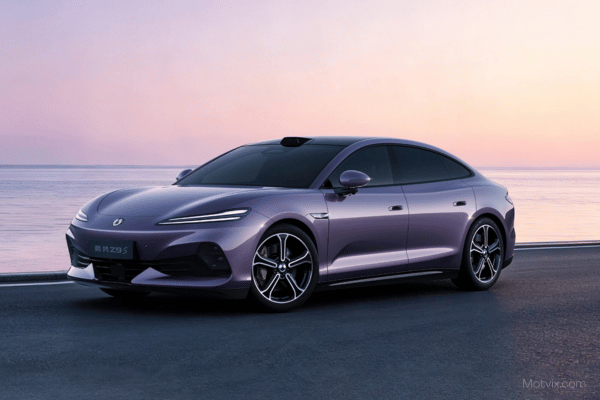
The Denza Z9S made its market debut on September 23, 2026, with three configurations priced from 255,800 yuan to 325,800 yuan. That is equivalent to approximately $37,900 to $48,300 at current exchange rates, although the vehicle’s price in any future export market would be different.
The most efficient configuration carries a claimed range of 1,100 kilometers under China’s CLTC testing procedure. Meanwhile, the performance model produces as much as 890 kW, or approximately 1,194 hp, from three electric motors.
These headline numbers apply to different versions of the car. Buyers must choose between the longest possible range and the most powerful drivetrain rather than receiving both specifications in the same vehicle.
Three versions with significantly reduced prices
Denza initially opened preorders for the Z9S in August. At that time, preliminary prices ranged between 319,800 and 389,800 yuan.
The final retail prices announced during the launch are considerably lower.
The Flash Charging Premium starts at 255,800 yuan, while the Flash Charging Flagship costs 275,800 yuan. The e3 Flash Charging Performance version sits at the top of the range at 325,800 yuan.
Compared with the original preorder figures, the three models are respectively 64,000, 74,000 and 64,000 yuan less expensive.
This aggressive pricing places the Z9S close to several versions of the Chinese-built Tesla Model 3, despite Denza positioning its car as a larger and more luxurious product.
The strategy illustrates the intensity of competition inside China’s electric vehicle market. Manufacturers are introducing more range, performance and cabin technology while simultaneously reducing prices.
Up to 1,100 kilometers of CLTC range
The two rear-wheel-drive versions use a single electric motor mounted at the rear. It produces 370 kW, or approximately 496 hp.
The entry-level Flash Charging Premium has a 102.326-kWh battery and a claimed CLTC range of 920 km.
Moving to the Flagship version adds a larger 122.496-kWh battery and increases the official CLTC range to 1,100 km.
Denza describes this as a global record for a mass-produced battery-electric vehicle. The previous figure highlighted by the company was the 1,036-km range announced for the updated Denza Z9GT.
The 1,100-km claim requires context. CLTC generally produces more optimistic numbers than the European WLTP procedure or the United States EPA test.
Driving quickly, using climate control and traveling in very hot or cold conditions can reduce the distance achievable in the real world.
Consequently, the Z9S should not be directly compared with an EPA-rated vehicle using only the published numbers. Nevertheless, the large battery and efficient single-motor drivetrain indicate that the Flagship version has been designed as a serious long-distance electric sedan.
Second-generation Blade Battery technology
All three versions use BYD’s second-generation Blade Battery.
The Blade design uses lithium-iron-phosphate cells arranged in long, narrow modules. BYD developed the system to improve packaging efficiency and structural integration while maintaining the durability and thermal characteristics associated with LFP chemistry.
The Z9S also employs cell-to-body integration, meaning the battery structure contributes directly to the vehicle’s body.
According to information released at the launch, the car’s steel and aluminum structure contains 91.1% high-strength material and achieves torsional rigidity of 45,036 Nm per degree.
High structural rigidity can help the suspension work more accurately while reducing unwanted movement and vibration through the body.
The battery is therefore not simply an energy storage component. It forms part of the vehicle’s overall engineering structure.
Charging from 10% to 70% in five minutes
Range is only one part of the Z9S technology story. Denza is also emphasizing extremely rapid charging.
The manufacturer says its flash-charging system can take the battery from 10% to 70% in five minutes. Charging from 10% to 97% is claimed to require nine minutes under suitable conditions.
Those results will require a compatible high-output charging station. Charging speed can also be affected by battery temperature, charger availability and the number of vehicles sharing the station.
Denza additionally reports that the Z9S can charge from 20% to 97% in 12 minutes at a temperature of minus 30 degrees Celsius.
These are manufacturer claims that will need to be confirmed through independent testing. If repeatable in normal use, they could reduce one of the largest differences between refueling a combustion vehicle and charging an electric car.
A 1,194-hp performance version
Customers prioritizing acceleration can select the e3 Flash Charging Performance model.
It uses a tri-motor all-wheel-drive system producing a combined 890 kW. Denza claims it can accelerate from zero to 100 km/h in 2.68 seconds.
Its smaller 102.326-kWh battery and performance-oriented drivetrain provide a CLTC range of 780 km.
That is substantially less than the Flagship model’s 1,100-km figure but still considerable for a vehicle with nearly 1,200 hp.
The performance version uses Denza’s e3 vehicle-control platform. Its three motors can manage power at individual wheels and support unusual maneuvering features such as a crab-walk mode and Compass Turn.
Rear-wheel steering is standard across the Z9S range. The top model has a minimum turning radius of 4.75 meters, an impressive figure for a sedan measuring more than five meters long.
The DiSus-A intelligent air suspension can adjust the vehicle’s ride characteristics according to road conditions and the selected driving mode.
Large dimensions and a premium cabin
The Z9S measures 5,090 mm long, 1,980 mm wide and 1,490 mm tall. Its wheelbase extends 3,025 mm.
Those dimensions place it firmly in the premium executive sedan category. The fastback roofline and frameless doors create a sportier profile, while an active rear spoiler can adjust according to driving conditions.
At the front, a 120-liter storage compartment provides additional cargo space. Customers can select from seven exterior colors and wheel designs measuring between 19 and 20 inches.
Inside, the dashboard incorporates a 17.3-inch central touchscreen, a 13.2-inch digital instrument cluster and a head-up display that projects information across an area equivalent to 50 inches.
Nappa leather upholstery, a suede headliner and metallic decorative elements reinforce the premium positioning.
Rear passengers receive a seven-inch control screen integrated into the center armrest. It can operate climate, entertainment and seat functions.
The front seats offer a zero-gravity configuration, while the rear cabin has been designed with a large central armrest and additional comfort equipment.
Advanced assistance and AI connectivity
A roof-mounted lidar sensor forms part of Denza’s God’s Eye 5.0 driver-assistance package.
The system supports navigation assistance on highways and urban roads, automated parking, emergency braking and emergency steering assistance.
These functions remain driver-assistance technologies. Their availability and operating limitations may vary by location, road and software version.
The cabin also introduces an AI assistant called Didixia, designed to control vehicle functions, navigation and compatible connected services through natural voice commands.
A 17.3-inch interface provides access to these features, while smartphone integration supports several major device manufacturers.
Denza also claims the Z9S is the first production vehicle to offer a small-window Apple CarPlay mode, allowing CarPlay information to appear without completely replacing the manufacturer’s main interface.
A demonstration of China’s EV development speed
The Denza Z9S is significant because it combines specifications previously associated with much more expensive vehicles.
It offers a large premium cabin, advanced suspension, rear-wheel steering and rapid charging at a starting price below 260,000 yuan.
The car is currently a China-market product, and Denza has not confirmed international availability for the Z9S. Taxes, homologation requirements and transportation expenses would also affect its price outside China.
Its 1,100-km range must be understood as a CLTC result rather than a guaranteed real-world distance. Even so, the model demonstrates how quickly battery capacity, charging performance and electric drivetrains are developing.