Nissan has unveiled the all-new Pixo, a compact electric vehicle developed specifically for crowded European cities and customers searching for an accessible way to switch to electric mobility.
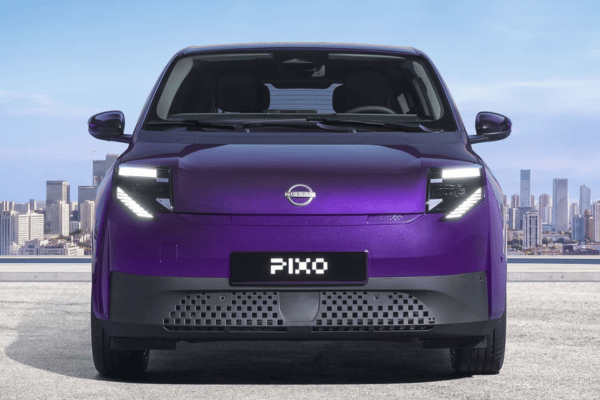
Presented on September 23, 2026, the new Nissan Pixo combines a small exterior footprint with four seats, flexible rear seating, Google-based connectivity and a claimed range of up to 259 kilometers, or approximately 161 miles.
The name previously belonged to a small gasoline-powered city car sold by Nissan between 2009 and 2013. However, the new model is an entirely different vehicle created for the electric era.
It will join the latest Nissan Micra and Leaf in the company’s expanding European electric range. Customer deliveries are expected to begin in early 2027, although prices and complete market-specific equipment packages will be announced later.
A small electric car designed for cities
The Pixo measures 3,796 millimeters long and 1,790 mm wide. Its compact dimensions should make it easier to use on narrow streets and in parking spaces designed for smaller European vehicles.
Nissan also quotes a turning circle of 9.9 meters. That figure is especially relevant for urban drivers who frequently need to make tight turns or maneuver inside crowded parking structures.
Despite its size, the vehicle can accommodate four adults. Its two rear seats slide independently, allowing the driver to prioritize either passenger legroom or cargo space.
If only one rear passenger is traveling, for example, the unused seat can be moved forward to create additional luggage capacity without removing the other passenger’s legroom.
Nissan lists a cargo capacity of 356 liters, although that figure includes a separate 50-liter area intended for charging cables. The passenger compartment provides an additional 18 liters of storage through different trays and compartments.
This flexibility could make the Pixo more useful than its exterior dimensions initially suggest. City cars are frequently used for shopping, school transportation and short weekend journeys, all of which require more versatility than a simple two-seat commuter vehicle.
A 27.5-kWh LFP battery
The Nissan Pixo uses a 27.5-kWh lithium-iron-phosphate battery. It is the first European Nissan model equipped with this type of battery chemistry.
LFP batteries generally avoid using nickel and cobalt, two comparatively expensive materials found in several other battery designs. They can also provide good durability and thermal stability, although their lower energy density may require more physical space for an equivalent amount of energy.
For a lightweight city car with a relatively small battery, LFP can provide an effective balance between cost, durability and daily driving range.
Nissan claims the Pixo can cover up to 259 km under the WLTP testing procedure. That should be sufficient for several days of typical urban driving, depending on the owner’s commute and access to charging.
Real-world range will vary according to speed, temperature, traffic, climate-control use and driving style. Frequent high-speed motorway journeys will normally consume energy more quickly than driving through a city.
The electric motor produces 60 kW, equivalent to approximately 82 hp. Nissan has not positioned the Pixo as a performance vehicle, but electric motors provide immediate torque that can make a small car feel responsive when moving away from traffic lights.
Rapid charging is standard
One of the Pixo’s most useful features is that 50-kW DC rapid charging will be fitted as standard across the range.
Nissan estimates that a compatible rapid charger can take the battery from 15% to 80% in approximately 28 minutes. The actual charging time will depend on battery temperature, the condition of the charging station and the amount of available power.
An 11-kW AC onboard charger is also included. This will allow owners to use compatible home, workplace and public AC charging stations without being restricted to slower charging speeds.
A regular 7-kW residential wallbox should be able to recharge the relatively small battery overnight. Drivers with access to an 11-kW three-phase connection could complete the same process more quickly.
Standard rapid charging is important because some inexpensive electric cars reserve their highest charging rate for optional packages or more expensive versions. Including it on every Pixo should make the entry model easier to use and potentially more attractive on the secondhand market.
Optional vehicle-to-load technology will allow the car’s battery to power compatible external electrical equipment. This could be useful for camping, outdoor activities or supplying energy to small devices when a conventional outlet is unavailable.
One Pedal technology for urban traffic
The Pixo will feature Nissan’s One Pedal technology, which allows drivers to accelerate, slow down and bring the vehicle to a stop primarily through movements of the accelerator pedal.
When the driver releases the accelerator, the electric motor changes its operation and helps reduce the car’s speed while recovering part of its kinetic energy.
This regenerative braking process sends energy back into the battery and can reduce the need to use the brake pedal repeatedly.
The brake pedal remains available and should always be used when stronger or emergency braking is required. Nevertheless, one-pedal operation can make stop-and-go traffic more comfortable.
It may also improve efficiency during city driving, where frequent deceleration provides more opportunities to recover energy.
Google and Gemini inside the Pixo
The interior combines a seven-inch digital instrument display with a 10-inch central touchscreen.
Google services are built into the infotainment system, providing access to connected navigation and other compatible applications without requiring the driver to rely exclusively on a connected smartphone.
Nissan also says the Pixo will integrate Gemini, Google’s artificial intelligence assistant. Drivers should be able to use conversational voice commands for supported functions and information.
The MyNissan mobile application will provide remote access to charging information and other vehicle functions. Availability may differ according to the country and the selected equipment level.
Face ID is another technology announced for the vehicle. Nissan has not yet provided every detail about how it will be used, but facial recognition could help load personalized settings or identify registered drivers.
The inclusion of modern connectivity is notable in a vehicle intended to occupy the affordable end of the electric market. Nissan appears to be treating the Pixo as a fully connected product instead of a basic car with important technology removed to reduce its price.
A distinctive pixel-inspired design
Although the Pixo shares part of its technical foundation with the Renault Twingo E-Tech Electric, Nissan has created a noticeably different exterior identity.
The upright profile is combined with pixel-inspired lights and an unusual front bumper. The pattern produces what Nissan describes as a playful retro robot-like face.
Short overhangs and wheels positioned near the corners help maximize passenger space while creating a stable stance.
The overall design is deliberately different from the smoother appearance of the latest Micra. This should allow the two electric models to serve different customers even though both are intended primarily for European roads.
The Pixo focuses on compact dimensions and affordability, while the Micra occupies a slightly larger and more conventional supermini position.
Why the Nissan Pixo matters
Affordable electric vehicles are becoming increasingly important in Europe. Many early EVs entered the market as expensive crossovers or premium sedans, leaving customers who wanted simple city transportation with relatively few choices.
The Pixo addresses that problem with a manageable battery, useful charging equipment and a body designed around urban practicality.
Its 161-mile range will not suit every long-distance driver, but installing an unnecessarily large and expensive battery would work against the vehicle’s purpose.
The most important unanswered question is the price. Nissan has not confirmed how much the Pixo will cost in each European market.
It will compete with vehicles such as the Renault Twingo E-Tech Electric, Hyundai Inster, BYD Dolphin Surf and other small EVs expected to arrive during the same period.
If Nissan can deliver a competitive starting price while retaining standard rapid charging and its advertised technology, the Pixo could become one of the company’s most relevant European electric vehicles.
It demonstrates that an EV does not need to be a large SUV with an enormous battery. For drivers who spend most of their time in cities, a smaller and more efficient car may be the more practical solution.