Ford has officially confirmed one of the most anticipated product announcements in the brand’s recent history. A pickup truck wearing the Bronco name is coming before the end of the decade, and it is part of a broader strategic shift in which Ford plans to transform several of its most popular nameplates — Bronco, Mustang, and Transit — into full vehicle subbrands, each anchored by multiple body styles rather than a single model.
The news was reported today by Automotive News, citing Ford’s plans as the automaker maps out its product strategy for the second half of this decade.
The Bronco Pickup: A Long and Complicated History
The idea of a Bronco pickup is not new. Ford decided to cancel the Bronco pickup truck in 2021, before the launch of the current sixth-generation Bronco SUV. At the time, the auto industry grappled with supply chain disruptions, and Ford could barely satisfy demand for the Bronco itself. Adding a new body variant would have been a logistical nightmare.
Now, five years later, the conditions have changed. Supply chains have normalized, and Ford has a clearer product roadmap. Ford plans to expand its lineup with a pickup version of the Bronco SUV, a four-door Mustang, and a smaller version of the Transit van. In addition to a Bronco hybrid in 2027 and a Bronco-based pickup near the end of the decade, it plans to keep adding new Mustangs, including a four-door variant it showed dealers this summer.
What the Bronco Pickup Could Look Like
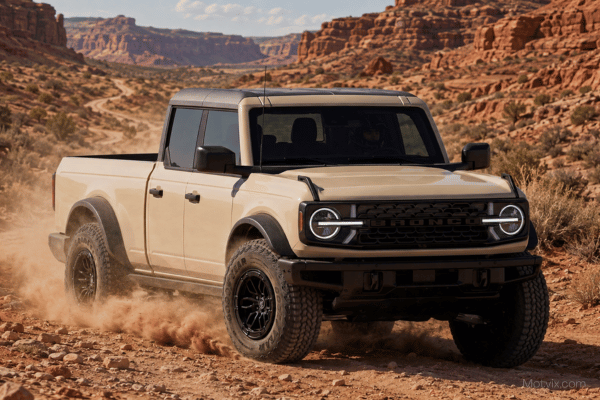
Ford has not released official images or specifications for the Bronco pickup. Based on what is known about the platform and the competitive landscape, the clearest blueprint is the existing Bronco’s architecture. The standard Bronco shares the T6 platform with the Ford Ranger, the mid-size pickup that is already one of Ford’s best-selling international products. A Bronco-based truck could logically share that same body-on-frame foundation, adding a rear cargo bed to the off-road-focused drivetrain and four-wheel-drive system that the Bronco SUV already uses.
The rugged model would likely sit alongside the midsize Ranger and the midsize electric Fathom in Ford’s truck hierarchy, positioning it above the compact Maverick and below the full-size F-Series lineup. That positioning would give Ford a differentiated off-road-focused mid-size truck to compete directly with the Jeep Gladiator — currently the only convertible-topped, body-on-frame mid-size truck in the US market — as well as the upcoming rugged pickup from Hyundai based on its Boulder concept.
Besides the new truck, the Bronco platform will reportedly spawn a new Lincoln off-roader, a rugged but luxurious SUV targeting premium buyers with an estimated starting price above $70,000. That Lincoln product would use the Bronco’s off-road DNA to take aim at the Mercedes-Benz G-Class from a price point significantly more accessible than the German icon.
Bronco as a Full Subbrand
The Bronco pickup announcement is inseparable from the broader strategic logic behind it. Ford is expanding its most popular nameplates into subbrands. The Mustang family is also rumored to gain a four-door coupe as part of the same strategy. Legacy carmakers are trying to figure out what works as electric vehicles remain a controversial topic and hybrids gain traction.
Ford already has two Bronco models: the full-size body-on-frame Bronco SUV, and the smaller, unibody Bronco Sport crossover. Adding a pickup would create a three-vehicle Bronco lineup, each appealing to a slightly different buyer within the same off-road, outdoors-oriented brand identity. A Bronco hybrid, confirmed for the 2027 model year, adds a fourth configuration.
The Mustang subbrand is following a similar trajectory. Ford’s Mustang Mach-E is already an electric crossover wearing the pony nameplate. A four-door Mustang sedan — shown to dealers this summer — would add a performance car format to the family. The result is a Mustang lineup that covers electric crossovers, traditional performance coupes and convertibles, and now a four-door option for buyers who want the name and the performance character without the two-door body constraint.
Transit is the third nameplate being expanded. A smaller Transit van — positioned below the existing Transit and Transit Connect — would give Ford a product for urban delivery, small business, and van life buyers who find the current Transit too large for their needs.
Why Ford Is Doing This Now
The subbrand strategy reflects a shift in how Ford thinks about brand investment. Rather than developing entirely new vehicle names from scratch — which requires building consumer recognition over years — the automaker is leveraging the equity already built into names that buyers already know and trust. Bronco, Mustang, and Transit are three of the most recognized vehicle names in American automotive culture. Expanding each into a family of models multiplies the commercial potential of that brand equity without starting from zero.
Ford has overhauled its EV plans and is now building smaller vehicles, including an electric pickup truck, using a completely new manufacturing process. On the other hand, it is also mulling an expansion of its most popular lineups. The two strategies are not contradictory — they reflect a Ford that is hedging appropriately across powertrains and body styles rather than committing entirely to any single technology or format.
What the Bronco Pickup Would Compete Against
In practical terms, the Bronco pickup would enter a segment that currently has only one meaningful competitor: the Jeep Gladiator. The Gladiator is a four-door pickup built on the same Wrangler platform, with removable doors and roof, a proper rear bed, and Jeep’s legendary off-road capability. It has sold well since its 2019 introduction, demonstrating that buyers exist for the concept of a serious off-roader in pickup form.
Hyundai is also developing an upcoming rugged pickup based on its Boulder concept, which would arrive around the same time as the Bronco pickup. The mid-size off-road truck segment is about to get significantly more competitive before the end of the decade.
What This Means for Buyers
For Bronco fans and off-road enthusiasts, today’s confirmation is exactly what many have been hoping for since the current Bronco launched without a pickup variant in 2021. A Bronco truck would offer the brand’s off-road credibility, removable-panel styling, and loyal community following in a format that adds genuine cargo utility. For buyers who currently cross-shop the Gladiator but want a Ford, it would finally offer a genuine alternative.
Ford has not disclosed pricing, powertrain options, or an exact timeline beyond “before the end of the decade.” The Bronco hybrid’s 2027 arrival will likely serve as the next indicator of how the broader Bronco subbrand expansion is progressing. Until then, today’s confirmation is the clearest sign yet that the Bronco pickup — canceled once, revived once, now official — is finally on its way.