BYD has offered the first official look at the second-generation Seal 07, revealing a significantly redesigned sedan that will be larger and more powerful than the current model.
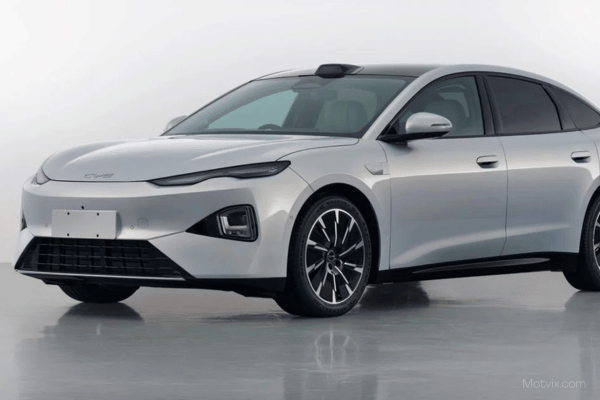
The Chinese automaker released official images of the vehicle on September 28, 2026.
The new Seal 07 will be offered with both battery-electric and plug-in hybrid powertrains, giving BYD another important model in its rapidly expanding electrified lineup.
Official pricing and a launch date have not yet been announced.
A Completely Redesigned BYD Seal 07
The new-generation Seal 07 introduces a noticeably different exterior design.
At the front, BYD has adopted sharper lines and redesigned daytime running lights.
The shape is cleaner and more aggressive than before.
From the side, the Seal 07 maintains a sleek fastback-inspired profile, while the rear features a full-width light bar.
The vehicle shown in BYD’s official images also uses semi-concealed door handles.
Another interesting detail is the roof-mounted LiDAR sensor.
Although BYD has not yet detailed the complete driver-assistance package, the presence of LiDAR suggests that selected versions could feature advanced driving assistance technology.
The New Seal 07 Is Bigger
Size is one of the most important changes.
According to regulatory information previously filed with China’s Ministry of Industry and Information Technology, the second-generation Seal 07 measures:
Length: 5,080 mm
Width: 1,960 mm
Height: 1,495 mm
Wheelbase: 2,960 mm
That makes it considerably larger than the battery-electric Seal 07 introduced earlier in 2026.
The new vehicle is approximately 85 mm longer and 50 mm wider, while the wheelbase has increased by 60 mm.
Its height remains unchanged.
Those dimensions move the Seal 07 deeper into the mid-to-large sedan category.
The longer wheelbase could also translate into more passenger space, especially for rear-seat occupants.
Up to 300 kW of Electric Power
BYD is also increasing performance.
Regulatory filings indicate that the battery-electric versions will be offered with motors producing approximately 245 kW and 300 kW.
That means the most powerful configuration could produce roughly 402 horsepower.
By comparison, the earlier electric Seal 07 launched with a maximum motor output of around 240 kW.
Both new electric versions are listed with a top speed of 240 km/h.
The combination of greater power and a larger body suggests BYD is positioning the new Seal 07 as a more premium and capable electric sedan.
Electric and Plug-In Hybrid Versions
BYD will continue offering customers more than one powertrain option.
The second-generation Seal 07 will be available as a fully electric vehicle as well as a plug-in hybrid.
The PHEV version will continue using the Seal 07 DM-i designation.
This follows BYD’s broader strategy of offering battery-electric and plug-in hybrid vehicles across several segments.
For consumers who have easy access to charging infrastructure, the battery-electric version will provide completely electric driving.
The DM-i version, meanwhile, can appeal to drivers who want electric driving for shorter trips while retaining an internal-combustion engine for longer journeys.
Blade Battery Technology Remains Important
The electric versions are expected to use lithium iron phosphate batteries.
BYD has become one of the world’s largest producers of LFP batteries through its Blade Battery technology.
The earlier Seal 07 EV introduced in March 2026 uses a 69-kWh second-generation Blade Battery.
That model offers a claimed driving range of up to 705 kilometers under China’s CLTC testing cycle.
BYD has not yet confirmed the final battery sizes or range figures for the second-generation model.
However, improvements in powertrain efficiency and battery technology could potentially allow the company to maintain or improve range despite the vehicle’s larger dimensions.
Actual figures will likely be released closer to launch.
Fast Charging Could Be Another Major Feature
The current Seal 07 EV is already one of the models using BYD’s newer flash-charging technology.
Fast charging has become one of the company’s biggest areas of development.
Chinese automakers are increasingly focusing on charging speed rather than simply installing larger batteries.
Shorter charging stops can make electric cars easier to use on long trips and reduce one of the most common concerns associated with EV ownership.
Although BYD has not yet released charging specifications for the second-generation Seal 07, the vehicle is likely to benefit from technology introduced across the company’s latest EV platforms.
LiDAR Signals More Advanced Driver Assistance
The roof-mounted LiDAR sensor visible on the prototype is another important clue.
LiDAR uses laser pulses to build a detailed picture of the vehicle’s surroundings.
Automakers can combine this information with cameras, radar and ultrasonic sensors to improve driver-assistance systems.
BYD has rapidly expanded advanced assistance technologies across its lineup.
However, not every trim level is guaranteed to receive the same hardware.
More details about the new Seal 07’s assistance systems are expected when the company reveals its full specifications.
BYD Is Expanding Quickly
The Seal family plays an important role in BYD’s Ocean Series.
The company has expanded the range into several sedan and SUV segments while also introducing multiple generations of its electric and plug-in hybrid technology.
The original Seal helped establish BYD as a stronger competitor in the electric sedan market.
The Seal 07 builds on that formula by offering more interior space and a broader focus on family-car usability.
BYD describes the new vehicle as a well-equipped mid-to-large family sedan.
That positioning could allow it to compete with larger electric sedans from established manufacturers as well as newer Chinese brands.
Pricing Has Not Been Announced
BYD has not yet revealed pricing for the second-generation Seal 07.
For context, the electric Seal 07 launched in China in March 2026 with two versions priced from 169,900 yuan, roughly $25,000 at the exchange rate used at the time.
The upgraded model could command a higher price because of its larger dimensions, stronger electric motors and additional technology.
However, BYD is known for aggressive pricing in its home market.
The final strategy will become clearer when the company announces launch details.
An Important Upgrade for BYD’s Electric Sedan Lineup
The second-generation Seal 07 represents more than a styling update.
A longer body, wider cabin, extended wheelbase and motors producing up to 300 kW indicate a substantial evolution.
Add LiDAR, electric and plug-in hybrid versions and next-generation battery technology, and BYD appears to be preparing the Seal 07 for increasingly strong competition.
The biggest unanswered questions now involve range, battery capacity, charging performance and pricing.
Those details will ultimately determine how much of an improvement the new model represents.
For now, however, the first official images show that BYD is giving the Seal 07 a significant step forward only months after introducing the current electric version.