After more than a decade without a coupe in its lineup, Peugeot has brought back one of its most iconic names. The French automaker unveiled the RCZ Vision concept on October 12 at the 2026 Paris Motor Show, reviving the distinctive double-bubble roofline that made the original RCZ a head-turner when it first appeared in 2009. What is underneath the familiar silhouette, however, is entirely new: a 500 horsepower all-electric powertrain, a solid-state battery developed in partnership with Factorial Energy, and a 1,000-volt electrical architecture capable of charging from 10 to 80 percent in just 10 minutes.
The Design: Old Soul, Radical New Direction
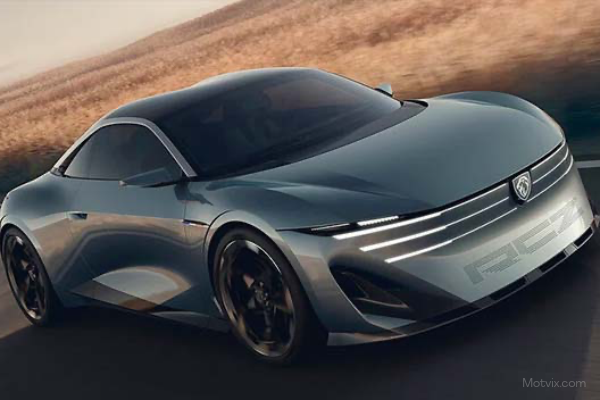
The original Peugeot RCZ was a real head-turner with its distinctive double-bubble curved roofline and sleek coupe profile. The RCZ Vision preserves that defining feature — and expands it dramatically. Where the original RCZ had a partial glass double-bubble section, unlike the original, the roof is now glass from the bonnet to the boot. The result is a greenhouse that wraps the entire upper section of the car in a continuous transparent surface, creating a visual lightness that contrasts with the muscular lower body.
Peugeot says the concept is the first with its new “Feline Future” styling language, with designers saying it has a “cat-like presence, leaning slightly forward and ready to pounce.” The front features Peugeot’s three-claw lighting signature in a new horizontal arrangement, along with a micro-perforated RCZ graphic on the front bumper. At the rear, the same three-claw motif is repeated alongside an illuminated Peugeot logo in the center. The car rides on 21-inch front and 22-inch rear forged aluminum wheels with a radiating-spoke design.
The concept uses an ultra-thin battery measuring just 110 mm in thickness, helping Peugeot create a low-profile body. That packaging decision is significant: one of the recurring challenges in building elegant electric coupes is managing the height added by battery modules in the floor. The ultra-thin solid-state pack keeps the RCZ Vision’s silhouette genuinely low and sleek.
The Powertrain: Solid-State, 1,000 Volts, 10 Minutes
The technical specification of the RCZ Vision is ambitious — and intentionally forward-looking. Peugeot claims it uses a 1,000-volt architecture, allowing rapid charging from 10 to 80 percent in just 10 minutes. Battery size wasn’t mentioned, but it has a solid-state battery developed with Factorial Energy. Range is estimated at 373 miles on a single full charge. As for power, it’s rated at 500 hp, which is far more than the most powerful RCZ model made over a decade ago.
Solid-state batteries remain largely pre-commercial at this scale, but partnerships like this one are part of how automakers are mapping the path from current lithium-ion technology to the next generation. Stellantis previously told us the platform would have 800-volt electrics and LFP batteries, but the RCZ imagines a more advanced future incarnation with 1,000-volt capability.
Based on our math from the stated energy consumption of 11.5 kWh/100 km, the battery must have a usable capacity of around 69 kWh. That figure — if accurate — would make the RCZ Vision remarkably efficient for a 500-horsepower coupe, pointing to the aerodynamic and drivetrain efficiency gains that solid-state chemistry and steer-by-wire systems can theoretically unlock.
The Cabin: Technology That Knows When to Step Back
Inside, Peugeot says the RCZ Vision offers a “digital experience that rejects the race for ever more screens”, so the central display can be switched off completely, allowing the driver to focus on steering the car.
The concept introduces Peugeot’s next-generation i-Cockpit setup, anchored by the Hypersquare — a rectangular steering control that first appeared on the Polygon Concept and is confirmed to arrive in production on the new e-208 next year. Transparent Micro LED displays provide information without the visual weight of traditional screens, and air vents retract into the dashboard when not needed.
Physical aluminum controls for functions including climate settings and drive modes remain on a floating console with a frosted-glass surface. That retention of tactile, physical controls alongside the digital interface is a deliberate design statement — Peugeot is positioning the RCZ Vision as a car for drivers who want technology that enhances rather than overwhelms.
Light-blue Alcantara and Pelinova material made using leather-industry offcuts bring color and texture into the cabin. There are four individual seats, and Peugeot says the rear pair can accommodate adults.
STLA One and What It Means for Production
The RCZ Vision showcases Peugeot’s new take on its design and rides on the new STLA One Stellantis platform. That detail matters. STLA One is Stellantis’ next-generation architecture designed to support over 30 production models across its brands by 2035, with confirmed cost efficiency improvements through component reuse. A concept built on a real production platform is meaningfully different from one built around a fictional architecture.
For now, the RCZ Vision should be viewed as a preview of Peugeot’s design and engineering direction, not a confirmed production model with final specifications or a launch date. Peugeot describes it as a “brand manifesto.” But unlike some concept cars that exist purely as design exercises, there seems to be a bit more to this than other far-fetched concepts, with Peugeot talking about the RCZ Vision using the new STLA One Stellantis platform.
What This Means for Buyers
The RCZ Vision does not have a confirmed production date, a price, or a launch market. What it does have is a clear design vocabulary — the Feline Future language — that is already confirmed for road cars, starting with the e-208 next year. The Hypersquare steering and Micro LED displays will reach production. And the STLA One platform is real.
For European coupe enthusiasts who remember the original RCZ fondly, the vision is compelling. A production version with even a subset of what the concept promises — the double-bubble roof, the low stance, a genuine electric sports coupe character — would fill a gap in the Stellantis portfolio that has been empty for more than a decade.