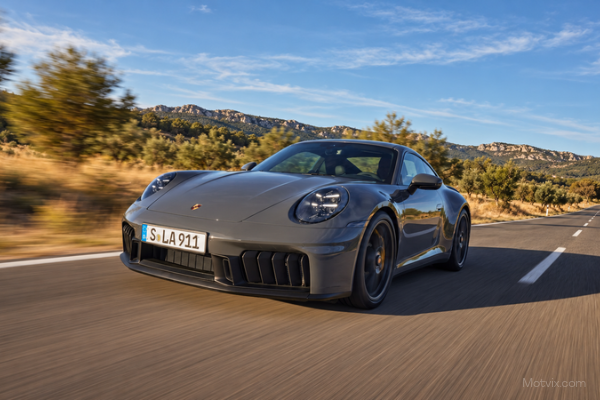
Porsche has made its clearest statement yet on the future of its most iconic model. “The 911 will never be electric”: here’s how Porsche plans on turning itself around. That declaration from Porsche’s leadership, published this week, draws a definitive line under a question that has circulated in the automotive world for years: would Porsche eventually bow to electrification pressure and replace the 911’s flat-six with a battery pack?
What Porsche Is Committing To
The 911 is the most important vehicle in Porsche’s lineup — not necessarily in volume, but in identity, profitability per unit, and brand definition. Since 1963, it has defined what a Porsche is. The flat-six engine, rear-engine layout, and continuous model evolution over six decades have created a brand identity that is inseparable from the combustion experience.
Porsche’s strategy for keeping the 911 relevant without full electrification centers on hybrid assistance and synthetic fuel compatibility. The current 911 GTS models already use a mild-hybrid system that adds torque fill and efficiency without changing the car’s fundamental combustion character. Future generations are expected to expand that hybrid integration while the brand continues to invest in eFuels — synthetic, carbon-neutral gasoline produced using renewable energy — as a path to reducing the 911’s net carbon impact without abandoning internal combustion.
Nine-month figures show Porsche volumes shrinking while 911 deliveries climb 12 percent, reflecting a push toward higher-margin sports cars and variants. That data point is revealing. Overall Porsche volumes are contracting — a consequence of slower demand for the Macan Electric and Cayenne in some markets — but the 911 is growing. Buyers are seeking out the one model that Porsche has confirmed will never be replaced by a battery pack.
The Broader Porsche Restructuring
The “never electric” statement does not mean Porsche is pulling back from electrification broadly. The Taycan electric sports car remains central to the brand’s future, the Macan Electric is in production, and the Cayenne is expected to receive an electric variant. Porsche is not abandoning EVs — it is deciding which models should be electric and which should not.
The restructuring Porsche is navigating involves several dimensions. Slower-than-expected EV demand in certain markets has required production adjustments. The Cayenne and Macan are the brand’s volume drivers, and both faces competitive pressure in a market where premium EVs from BMW, Mercedes, and emerging Chinese brands are competing for the same buyers.
Meanwhile, the 911, Boxster, Cayman, and Panamera occupy the brand’s performance and ultra-premium tiers — segments where buyers are demonstrably willing to choose combustion or hybrid over full electrification, and where the emotional experience of the powertrain is part of the product itself.
Why This Matters Beyond Porsche
The 911’s exemption from electrification is significant for the broader industry because Porsche is one of the most profitable automakers in the world on a per-vehicle basis. If any company could absorb the cost of developing a fully electric 911 and marketing it successfully, Porsche could. The fact that it has chosen not to — and has said so publicly — validates a position that other brands have been reluctant to state clearly: some vehicles derive so much of their value from their powertrain character that electrifying them would fundamentally undermine the product itself.
For 911 buyers, the message is unambiguous. The car they love will continue to exist in the form they love it — with a combustion engine, driver engagement, and the acoustic experience that has defined it for six decades. The question of range anxiety, charging infrastructure, and EV transition simply does not apply to the 911. That clarity, in a market full of uncertain powertrain promises, may be one of the most powerful things Porsche can say right now.