Renault has officially unveiled the Niagara, a new double-cab pickup developed specifically for Latin America. Presented on September 10, 2026, the model combines the practical capabilities of a pickup with the comfort, connectivity and safety technology normally associated with a C-segment SUV.
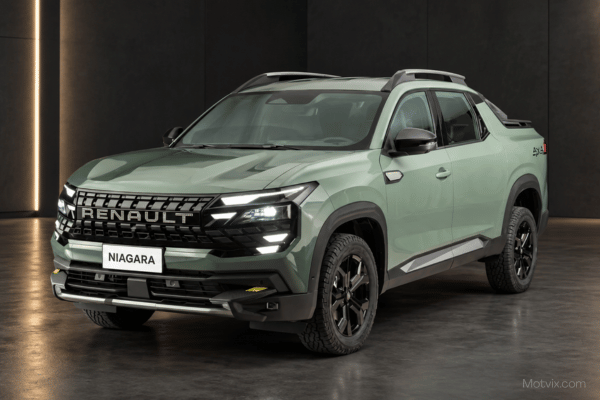
The Niagara will be manufactured at Renault’s Santa Isabel plant in Argentina. Brazil, Argentina and Colombia will be its principal markets, although the automaker plans to introduce the truck in other Latin American countries at a later stage.
Designed and Built in Latin America
Unlike a global model adapted after its original development, the Renault Niagara was designed, engineered and will be manufactured in Latin America.
It uses Renault’s RGMP pickup platform, created to accommodate different powertrains, transmissions and drivetrain configurations. According to the company, Niagara will be the only pickup in its segment produced locally in Argentina.
The model also represents the first product in Renault’s futuREady international strategy. Under that plan, the manufacturer intends to introduce 14 new models outside Europe by 2030 and eventually generate half of its global sales in international markets.
Latin America is particularly important to this strategy because pickups represent a substantial part of the regional vehicle market. Renault wants the Niagara to attract customers who need a truck for work while also using it as their primary personal or family vehicle.
A Pickup With SUV Comfort
The Niagara adopts a double-cab body and a cargo bed integrated into the overall design. Its prominent front section, protective exterior elements and elevated stance give it a more rugged appearance than the Oroch, Renault’s previous compact pickup offering.
However, the company is placing just as much emphasis on comfort as it is on utility.
Inside, the Niagara features Renault’s OpenR Link infotainment system with Google services and Gemini integration. This should provide access to navigation, connected functions, voice assistance and compatible applications through the vehicle’s central display.
The equipment list also includes Renault’s Multi-Sense system, customizable ambient lighting and several storage areas intended for everyday use.
Multiple Drivetrain Configurations
Renault will offer the Niagara with manual and automatic transmissions, depending on the version and market. Customers will also be able to choose between two-wheel-drive and four-wheel-drive configurations.
The manufacturer has not yet published a complete list of engine specifications, output figures, payload ratings or prices. Initial versions are expected to use combustion engines.
A hybrid powertrain will be added later because the RGMP platform was developed to support electrified configurations. This future variant will contribute to Renault’s objective of making hybrid and electric vehicles account for 50% of its international product mix by 2030.
The absence of a hybrid model at launch indicates that Renault is taking a gradual approach to electrification in a region where charging infrastructure and purchasing power vary significantly between countries.
Driver-Assistance Technology
The Niagara’s available safety equipment will bring several modern driver-assistance features to the pickup segment.
Renault’s published materials show technology including adaptive cruise control, automatic emergency braking, blind-spot monitoring, lane-keeping assistance and traffic-sign recognition. Other available features include a 360-degree camera, rear cross-traffic alert, driver monitoring, hill-descent control and hands-free parking.
Equipment levels will likely differ between versions and markets, so not every feature should be expected to come standard.
Why the Niagara Matters
The Niagara enters a competitive category that includes models such as the Fiat Toro, Ram Rampage, Ford Maverick and Chevrolet Montana. Its local production, multiple drivetrain choices and connected cabin could help Renault compete more directly in this increasingly important market.
More importantly, Niagara shows that Renault is developing dedicated products for Latin America instead of treating the region as a secondary destination for models conceived elsewhere.
Final prices, engine specifications and country-specific launch dates will determine how competitive it ultimately becomes. Nevertheless, the Niagara already represents one of Renault’s most important regional introductions in recent years.