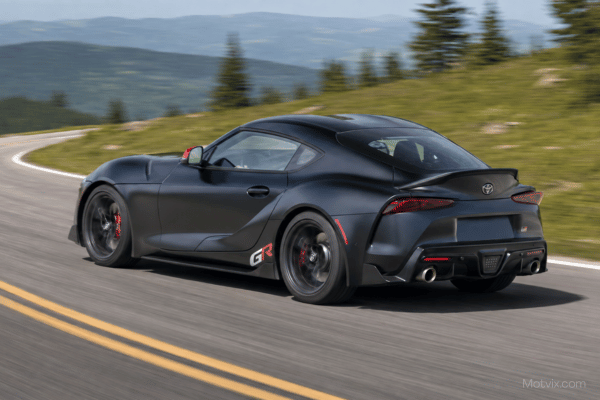
Production of the fifth-generation Toyota GR Supra ended in March 2026. What remains in US showrooms now — in dwindling numbers — is the MkV Final Edition: a 382-horsepower farewell to a six-year run that revived one of the most celebrated sports car nameplates in Japanese automotive history. It is also the end of the BMW partnership that made the car possible. The next Supra will be developed entirely by Toyota, in-house, on a new platform with a new engine. This is the last one before that chapter begins.
Why the Supra Came Back — and Why the BMW Partnership Made Sense
The fifth-generation GR Supra was introduced for the 2020 model year, ending a 17-year absence of the nameplate from the market. Toyota chose to co-develop the car with BMW, sharing the platform and inline-six engine with the BMW Z4 roadster. That decision generated intense debate among Supra enthusiasts, many of whom had hoped for a purely Japanese-engineered successor to the legendary 2JZ-powered A80 generation.
In practice, the co-development produced a car that was genuinely excellent to drive. Toyota’s 3.0-liter turbocharged inline-six sends 382 horsepower and 368 lb-ft of torque to the rear wheels through an eight-speed automatic, with a six-speed manual available at no additional cost. In Edmunds’ testing, a GR Supra with the automatic rocketed to 60 mph in 4.2 seconds, with brakes and sticky tires stopping the car from 60 mph in just 105 feet.
Six years later, Toyota has decided not just to end the current generation but also to end the partnership with BMW on its halo sports car. Toyota will go it alone on the next-gen model, developing it fully in-house with a new rear-wheel drive platform and a new engine.
What the Final Edition Actually Changes
The MkV Final Edition is not a radical departure from the car it commemorates. It is, as one reviewer put it, the GR Supra notched up approximately ten percent — focused improvements in the areas that matter most on a track-capable sports car.
Hardware changes include larger 14.7-inch front brake discs, new suspension bushings, and a revised underbody brace. Front wheel arch flaps improve aerodynamic efficiency at higher speeds, and the suspension geometry has been revised for more front-end grip — addressing one of the criticisms most consistently leveled at the standard car, which some drivers found prone to oversteer in demanding conditions.
The US Final Edition is limited to 900 units. A more hardcore version, limited to 300 units and earmarked solely for European and Japanese markets, gets a 429-hp engine tune, KW suspension, a swan-neck rear wing, a GT4-sourced subframe, and skeletonized carbon seats. American buyers do not receive that more extreme specification, but the 900-unit US allocation still ensures meaningful scarcity.
The 2026 Toyota GR Supra MkV Final Edition starts at $70,545. The standard GR Supra 3.0 begins at $59,495, making the Final Edition approximately $11,000 more expensive — a premium that reflects its limited production status, the chassis and brake hardware upgrades, and the collectibility that a final edition of any beloved nameplate commands.
The GT4 Style Pack and Available Options
For buyers who want to push the Final Edition’s visual drama further, Toyota offers an optional GT4 Style Pack that adds Toyota Gazoo Racing red-painted carbon fiber mirror caps, GT4 exterior graphics, and a wind-buffering kit. A Driver Assist Package adds Blind Spot Monitor, Full Speed Dynamic Radar Cruise Control, Rear Cross-Traffic Alert, and Parking Sensors with Emergency Braking for buyers who want the safety technology alongside the performance hardware.
The car is available in both automatic and manual transmission configurations. The six-speed manual is offered at no additional cost on the Final Edition — a detail that matters for enthusiasts who consider a proper gearbox non-negotiable in a sports car of this character.
What Comes Next: A Toyota-Built Supra
The end of the BMW partnership marks the beginning of a new chapter. Toyota has confirmed a sixth-generation Supra is planned, developed entirely in-house without shared platform or powertrain obligations to another manufacturer. A successor is planned but not yet detailed.
What is known is that Toyota’s next major new engine — the Skyactiv-Z inline-six — is expected to debut in a production car by late 2027, most likely in a hybrid CX-5 crossover. From there, the engine could find its way into the next Supra, though the timeline and exact configuration remain unconfirmed. A purely in-house sports car from Toyota’s Gazoo Racing division, built on a purpose-designed platform rather than a shared one, is exactly what many Supra fans have been asking for since 2019. The wait now begins in earnest.
Why the Final Edition Matters for Buyers Right Now
Production of the fifth-generation GR Supra ended in Spring 2026. The 900 Final Edition units allocated for the US are the last of this generation that will be sold new, and dealer allocations are running down. For buyers who want this car — the BMW-engined, co-developed Supra that divided opinion and then won people over with its driving dynamics — the window is closing.
Whether the Final Edition will appreciate in value depends on how the Supra’s legacy develops once the next generation arrives. The A80 Supra — the 1993–1998 generation with the legendary 2JZ engine — is now worth multiples of its original price, driven by nostalgia, motorsport culture, and genuine scarcity. The MkV is a different car for a different era, but it carries the same name, the same rear-wheel drive formula, and the same commitment to driving involvement that defines what a Supra is supposed to be. That may count for more than critics expected when the car was new.