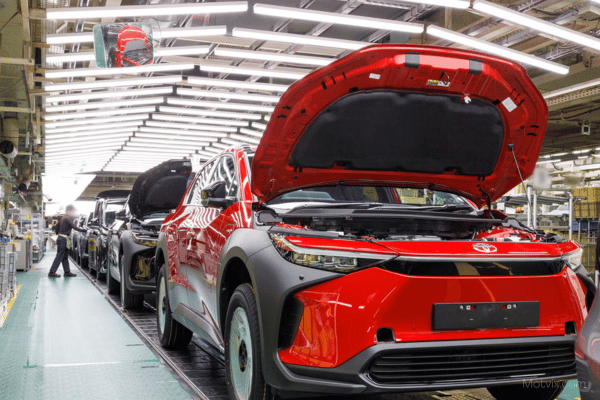
Toyota is navigating one of the most difficult production periods in its recent history. Just as the world’s largest automaker was beginning to recover from a powerful earthquake that struck Japan’s Kumamoto region on July 28, a typhoon made landfall on August 7 — forcing Toyota to suspend operations at nine factories and 17 production lines across the country.
The Earthquake: A Slow-Motion Disruption
A 7.1-magnitude earthquake struck Kumamoto prefecture on July 28, killing at least 13 people, damaging roads, and knocking out power to thousands of homes. Toyota confirmed it would suspend operations at three plants in Kyushu — its Miyata, Kanda, and Kokura facilities — citing the earthquake’s impact on suppliers and logistics.
Production was initially halted from July 28 through July 29, but the shutdown was extended through July 31. Reuters later reported that the three plants would remain offline through August 5. Toyota also suspended operations at a fourth plant due to supplier shortages caused by the quake’s impact on the region’s parts network.
The Miyata plant is one of Toyota’s most important in Japan. It makes a wide range of Lexus luxury models and has an annual production capacity of around 430,000 vehicles. The Kanda and Kokura plants produce hybrid car units and engines. The Tahara plant, which builds the Land Cruiser 250 and Lexus GX for the US market, was also idled through August 7 as part of the disruption.
Other automakers were also affected. Nissan partially suspended production at its two Kyushu vehicle plants because of delays in parts deliveries. Honda suspended production at its Kumamoto motorcycle factory — Japan’s only Honda motorcycle production base — to conduct inspections and carry out repairs following flooding inside the facility. Honda subsequently extended shutdowns to include plants making the Civic and Prelude.
Chipmaker Renesas Electronics, which supplies critical microcontrollers used across the global auto industry, also halted operations at two Kumamoto facilities that reported structural damage including fallen ceiling panels, wall cracks, and water leaks.
A Typhoon Compounds the Crisis
Just as production lines were beginning to restart in early August, a typhoon struck Japan on August 7. Toyota suspended 17 production lines at nine plants — including subsidiaries — as a result of the storm. The back-to-back events have created an unusually prolonged disruption for a company whose just-in-time manufacturing system depends on reliable, continuous parts flow.
The total estimated output loss from both events is approaching 20,000 vehicles, based on figures reported during the earthquake phase alone. With the typhoon adding additional downtime, the final number is expected to be higher once all plants have fully restarted and assessed backlog.
What This Means for US Buyers
For American consumers, the most direct impact is on models built in Japan specifically for the US market. Toyota’s Tahara plant, which makes the Land Cruiser 250 and Lexus GX, was among the facilities idled for an extended period. Toyota has not disclosed the full extent of the disruption there.
Dealers and analysts note that production stoppages of this length rarely translate immediately into US inventory shortages — Toyota typically maintains several weeks of vehicle buffer stock — but if disruptions persist or expand, pricing pressure on affected models could begin to build by late autumn.
Supply Chain Resilience Under the Microscope
Japan’s Kyushu island is one of the most concentrated automotive and semiconductor manufacturing zones in Asia. The region is home not only to Toyota, Nissan, and Honda facilities, but also to critical chip and component suppliers that feed production lines globally.
Analysts who observed the situation drew comparisons to the 2011 Tohoku earthquake and the 2016 Kumamoto earthquakes, both of which temporarily disrupted global auto supply chains. However, they also noted that Japan’s manufacturing sector has invested significantly in resilience since those events.
Nomura Research Institute executive economist Takahide Kiuchi said the negative impact on production activity and supply chains would likely be relatively temporary, as many shutdowns appeared driven largely by worker safety precautions rather than permanent damage to production facilities.
A Reminder About Concentration Risk
The back-to-back disruptions in Japan are a reminder that geographic concentration in manufacturing — even in a highly advanced economy with strong earthquake preparedness — carries inherent risk. For an industry that had already experienced severe supply chain disruption from the COVID-19 pandemic and the global chip shortage earlier this decade, the events in Kyushu add another chapter to an ongoing conversation about how to build more geographically distributed production networks.
Toyota has not disclosed a timeline for full resumption of all affected facilities. The company said it is assessing the situation daily as typhoon recovery and earthquake aftershocks continue.