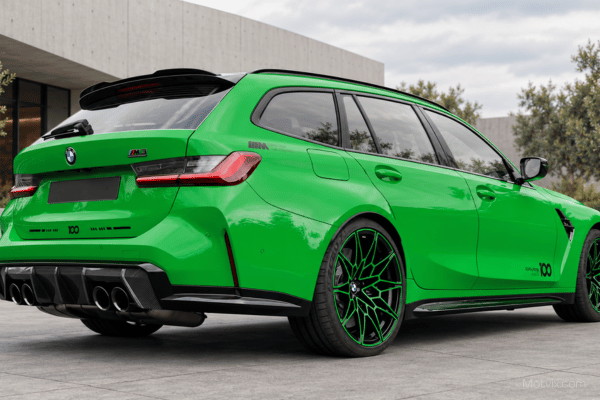
BMW M and BMW Motorrad have created a nine-model “100 Jahre Nürburgring” collection for the circuit’s centenary in 2027. The lineup includes special versions of the BMW M2, M3 Sedan, M3 Touring, M4 Coupé, M5 Sedan and M5 Touring, joined by the M 1000 RR, M 1000 R and M 1000 XR motorcycles.
The Nürburgring officially opened on June 18, 1927, making the project a tribute to a venue that has influenced both motorsport and road-car development.
The collection’s strength is coherence. Instead of placing one anniversary badge on unrelated products, BMW uses a shared color, graphics and material language across cars and motorcycles.
Each model retains its own shape and purpose, but the group is visibly connected to the same circuit. The result shows how heritage design can be specific without becoming a costume.
Nürburgring Green creates the link
All nine models use a historical Nürburgring Green finish developed for the edition, paired with light gray, black and model-specific green accents.
The cars carry a centenary logo, “Nürburgring since 1927” lettering and a silhouette of the circuit.
Graphics appear on areas such as the doors, C-pillars or rear quarter panels depending on the body style.
Roof stripes provide another common element. On the M2, M3 Sedan, M4 Coupé and M5 Sedan, they cross an M carbon roof.
The M3 Touring and M5 Touring use the same graphic idea on their steel roofs.
Black Sapphire metallic is available as an alternative exterior color for customers who prefer a more restrained base.
Inside, black upholstery is contrasted with green and white stitching.
The inline-six models receive an M Alcantara steering wheel with matching details and a twelve-o’clock marker, while the M5 models use an M steering wheel with the same visual signature.
These touches are familiar performance-car cues, but the consistent palette keeps the cabin connected to the exterior story.
Motorcycles receive individual numbering
The three BMW Motorrad editions are each limited to 100 units worldwide.
Their fuel tanks carry a Nürburgring silhouette, while the airbox cover receives an anniversary design and an individual “one of 100” marking.
Carbon wheels feature green accent stripes, and the Alcantara-look seat is embroidered with “100.” A black swingarm and rear frame complete the darker mechanical background.
Standard equipment includes the M Track Package.
BMW also adds an M Cover Kit for the M 1000 RR and M 1000 R, an anniversary motorcycle mat and a rear paddock stand.
Those accessories extend the design into the garage or paddock, where limited-edition owners are likely to display and maintain the bikes.
Restricting each motorcycle to 100 units makes scarcity part of the design.
BMW has not yet published full ordering and availability details for the bikes, so interested customers will need to wait for market-specific information. Pricing has also not been disclosed in the initial release.
Performance technology beneath the graphics
The anniversary cars are based on current high-performance M models rather than being cosmetic packages on standard vehicles.
The M2, M3 and M4 use BMW M Ignite, a patented pre-chamber ignition system introduced into the relevant inline-six engines during July and August 2026.
BMW says it improves efficiency under high load, reduces consumption in circuit driving and helps the engines meet Euro 7 requirements without reducing performance.
Pre-chamber ignition creates a more energetic and distributed combustion event than a conventional spark plug acting alone.
In a performance application, the potential advantage is stable, efficient combustion when the engine is under sustained load.
The technology is a fitting element for a Nürburgring edition because it represents engineering transfer from demanding development conditions rather than decoration alone.
The M5 Sedan and M5 Touring retain their M Hybrid powertrains, combining high output with the ability to operate electrically in selected conditions.
Across the lineup, the models represent different interpretations of performance: compact coupe, sports sedan, practical wagon, grand touring coupe and electrified flagship.
Why the Nürburgring remains a development benchmark
The Nordschleife measures 20.8 kilometers and includes 73 corners, major elevation changes and constantly varying surfaces and speeds.
Those conditions place simultaneous stress on brakes, suspension, aerodynamics, tires, thermal management and power delivery.
A car that remains predictable there has endured a concentrated test of systems that also matter on public roads.
BMW’s relationship with the circuit dates to 1927, when the brand achieved its first victory there.
Today, the Nürburgring functions as a testing venue, a marketing symbol and a cultural reference point for enthusiasts.
The centenary collection uses all three roles, but its most credible link is the company’s continuing development work on the track.
Track performance should never be confused with safe behavior on public roads.
The value of circuit testing is controlled validation at extremes, not encouragement to approach those extremes in normal traffic.
That context allows the “Born on the Racetrack. Made for the Streets.” theme to make practical sense.
Availability and the appeal of continuity
Orders for the M3 Sedan, M3 Touring, M4 Coupé, M5 Sedan and M5 Touring editions are scheduled to open in September 2026.
The M2 follows in January 2027. BMW says motorcycle ordering details will be announced separately.
The company has not stated production limits for the cars in the initial release, unlike the clearly numbered bikes.
This is positive design news because the collection celebrates a place through a complete visual system and relevant engineering.
The green paint has historical meaning, the circuit silhouette is immediately recognizable and the pre-chamber ignition provides a technical story beneath the surface.
Most importantly, the nine machines remain identifiable as themselves.
Anniversary products can easily become overloaded with logos. BMW’s collection works best where it shows restraint: one strong color, a limited graphic vocabulary and materials that suit high-performance vehicles.
For collectors, it creates rarity. For the wider audience, it offers a clear example of how automotive heritage can inform modern design without freezing it in the past.