General Motors is reportedly preparing to produce far fewer Chevrolet Bolt EVs than originally expected, highlighting how quickly the electric vehicle market in the United States continues to change.
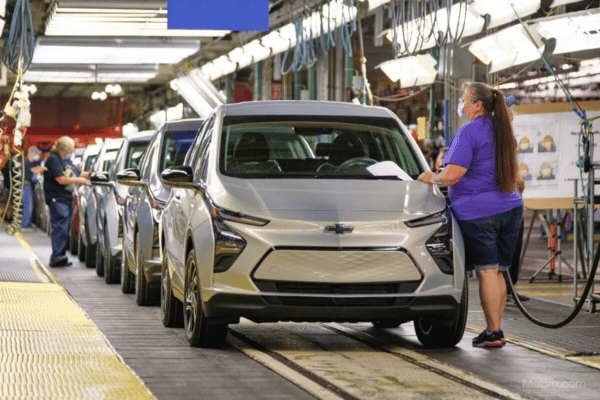
The Kansas City-area factory building the small electric vehicle is now expected to manufacture approximately 35,000 units before Bolt production ends during the first quarter of 2027.
That compares with an earlier expectation of roughly 150,000 vehicles, according to Dontay Wilson, president of the local United Auto Workers chapter representing employees at the plant.
If those estimates prove accurate, total Bolt production would be approximately 75 percent lower than previously anticipated.
However, there is an important qualification.
The 35,000-unit estimate comes from the union and is based on daily production volumes. General Motors has not officially confirmed a specific Bolt production target.
GM Has Not Confirmed the 35,000 Figure
General Motors declined to provide Reuters with expected production volumes.
Instead, the company said it continually evaluates market conditions and customer demand.
That means the reported reduction should not be interpreted as an official GM production forecast.
Nevertheless, daily production rates at the plant suggest output will be dramatically lower than initially anticipated.
The Bolt is currently described by General Motors as a limited-run model.
Production is expected to end during the first quarter of 2027.
The Chevrolet Bolt Returned as an Affordable EV
The Bolt name has an important place in Chevrolet’s electric vehicle history.
The original Bolt was one of the first relatively affordable long-range EVs from a major U.S. automaker.
General Motors later ended production before bringing the nameplate back as part of its newer electric vehicle strategy.
The latest Bolt carries a starting price of approximately $27,600, making it one of the more affordable new electric vehicles available in the United States.
That positioning makes the reported production reduction particularly interesting.
Affordable electric cars are widely considered important for increasing EV adoption beyond premium buyers.
However, lower prices alone do not guarantee strong demand.
Sales Have Remained Relatively Low
Through August 2026, Chevrolet had sold only around 4,224 Bolt EVs, according to figures cited by Reuters.
Those numbers help explain why GM may not need the production volume previously expected.
Consumer demand for electric vehicles in the United States has changed considerably following policy and incentive changes.
The expiration of the federal $7,500 consumer EV tax credit removed an important financial incentive for many buyers.
Automakers have consequently adjusted production plans and investment strategies.
GM is not abandoning electric vehicles entirely, but it has become more cautious about matching production with actual customer demand.
Around 1,000 Workers Remain on Layoff
Lower Bolt production also has consequences for the workforce.
According to the union, the reduced production rate delayed plans to bring a second manufacturing shift back to the Kansas City-area facility.
Approximately 1,000 workers remain on indefinite layoff, according to the local UAW president.
The situation illustrates the complex employment effects of changing vehicle demand.
Automakers invested billions of dollars preparing factories for electric vehicles, but slower-than-expected demand has forced some manufacturers to adjust their original plans.
The Factory Is Not Being Abandoned
The end of Bolt production does not mean General Motors plans to leave the factory idle.
GM is preparing to bring additional gasoline-powered vehicle production to the facility.
The company plans to manufacture the gasoline-powered Chevrolet Equinox there beginning next year.
That model is currently produced in Mexico.
GM also intends to move production of the Buick Envision from China to the Kansas City-area factory.
Those changes could eventually increase activity at the plant even as Bolt production winds down.
GM Has Scaled Back Some EV Investments
General Motors remains one of the largest EV manufacturers in the United States.
The company continues to offer multiple electric vehicles across Chevrolet, GMC and Cadillac.
However, GM has also reduced some of its earlier EV ambitions.
Reuters reports that the automaker has recorded approximately $10.9 billion in EV-related charges since mid-2025 while modifying manufacturing plans and adapting some facilities for gasoline-powered vehicles.
This does not mean GM is abandoning electrification.
In fact, on the same day as the Bolt production report, GM and LG Energy Solution announced plans related to lower-cost battery technology at their joint-venture battery plant in Tennessee.
The companies plan to prepare the facility for lithium manganese-rich prismatic battery cells intended for future GM EVs.
The combination shows how GM’s strategy is evolving.
The company is still developing EV technology while becoming more selective about individual vehicle programs and production volumes.
The U.S. EV Market Is Changing Quickly
The Bolt situation reflects a broader shift across the American automotive industry.
Several manufacturers have delayed EV programs, reduced production targets or increased their focus on hybrids and gasoline-powered vehicles.
Consumer demand, charging infrastructure, fuel prices, government incentives and vehicle costs all influence these decisions.
At the same time, automakers cannot simply stop investing in EV technology.
Electric vehicles continue to expand in many international markets, particularly China.
Manufacturers therefore face the difficult task of adapting their strategy to very different regional markets.
What Happens to the Chevrolet Bolt Next?
Current information indicates that Bolt production will finish during the first quarter of 2027.
If the union estimate is accurate, approximately 35,000 examples of the latest Bolt will have been produced by then.
That would make the vehicle considerably less common than originally expected.
For buyers interested in an affordable Chevrolet EV, availability could therefore become more limited as production approaches its conclusion.
The bigger story, however, goes beyond a single model.
GM’s decision-making around the Bolt illustrates how rapidly automakers are adjusting to changing EV demand.
The company still sees electric vehicles as part of its future, but it is increasingly balancing that strategy with hybrids, gasoline vehicles and lower-cost battery technology.
For the Chevrolet Bolt, that changing market could make its latest return much shorter than originally anticipated.