Honda is developing technology that could dramatically change the way electric vehicles recharge.
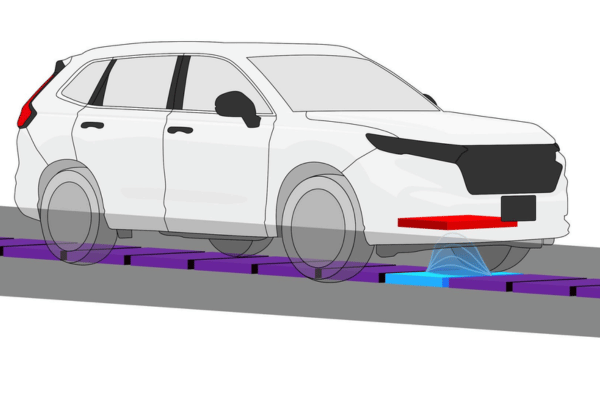
Instead of requiring drivers to stop at a charging station, the Japanese manufacturer is working on a road system capable of wirelessly supplying electricity to an EV while it is moving.
Honda announced the latest development on October 5, 2026, revealing that Honda R&D has been working with Taisei Corporation and Taisei Rotec Corporation on a magnetic-coupling wireless power transfer road system.
The technology is being designed not only for passenger cars, but also for large commercial electric vehicles.
Eventually, Honda plans to test power transfer at levels of up to 150 kW.
Charging an EV Without Plugging It In
The basic idea behind Honda’s technology is relatively simple.
Special power-transmitting equipment is embedded beneath the road surface.
A compatible receiver installed underneath the electric vehicle collects electricity as the vehicle passes over the equipped portion of the road.
This process is known as Dynamic Wireless Power Transfer, or DWPT.
Unlike a conventional wireless charging pad that requires the vehicle to remain parked, dynamic charging works while the vehicle is moving.
That could allow an electric truck, bus or passenger vehicle to recover energy without stopping.
Honda believes the technology could ultimately reduce the amount of time EV drivers need to spend at traditional charging stations.
Honda Has Been Developing the Technology Since 2021
Honda says it has been working on dynamic wireless power transfer technology since 2021.
In 2025, Honda R&D began joint research with Taisei and Taisei Rotec to develop a practical magnetic-coupling system that could eventually be installed in public roads.
Each company brings a different area of expertise to the project.
Honda is responsible for the power-transmission system embedded in the road and the receiver installed in the vehicle.
Taisei is developing the high-response DC power supply.
Taisei Rotec is responsible for developing methods to install the system within road pavement.
Together, the companies are attempting to create a system that can withstand normal traffic while reliably delivering large amounts of electricity.
Designed to Handle 20-Ton Vehicles
Building wireless charging equipment into a road creates several engineering challenges.
The charging components must be strong enough to survive thousands of heavy vehicles driving over them.
Honda says its development work has therefore focused on pavement structures capable of supporting commercial vehicles with a gross vehicle weight of approximately 20 tons.
The internal structure of the power-transmitting units has been designed to withstand repeated heavy loads over extended periods.
That is particularly important if the system is eventually installed on highways used by trucks.
Commercial vehicles could become one of the first major applications for the technology.
Why Electric Trucks Could Benefit Most
Large electric trucks require enormous batteries because they travel long distances while carrying heavy loads.
Those batteries increase vehicle weight and cost.
Charging also becomes more complicated because commercial operators cannot afford long periods of downtime.
A road that provides electricity while a truck is moving could address several of those problems.
If trucks can regularly receive power during a journey, manufacturers may eventually be able to reduce the size of their batteries.
Smaller battery packs could reduce vehicle weight and potentially increase cargo capacity.
Drivers could also spend less time waiting at charging stations.
Honda says logistics and transportation are among the sectors where it expects dynamic wireless charging to provide significant benefits.
Up to 150 kW of Wireless Power
Honda and its partners plan to evaluate the technology at high power levels.
Future development testing will include wireless power transfer of up to 150 kW.
That amount of power is comparable to the output provided by many conventional DC fast chargers.
The major difference is that the vehicle would receive that electricity while traveling.
Honda also needs to prove that power can be transferred efficiently and reliably at highway speeds.
That will be an important part of upcoming testing.
The Road Itself Becomes Part of the Charger
Honda’s system uses multiple transmitting units embedded beneath the pavement.
The units are connected through a DC distribution system.
Each unit integrates an inverter and a coil into a single assembly.
Honda says this configuration simplifies the wiring required beneath the road and can make the equipment easier to install.
The system has also been designed so that it can potentially be added to existing pavement.
Installation would involve removing sections of the road surface, embedding the charging equipment and restoring the pavement.
The ability to retrofit existing roads could become important if the technology eventually reaches commercial deployment.
Building completely new highways specifically for wireless charging would be considerably more expensive.
One Million Wheel Loads Will Test Durability
Before the technology reaches public roads, Honda and its partners will conduct extensive durability testing.
A new test roadway is scheduled to be constructed in late 2026 at Taisei Group’s Future Technology Field in Tamura, Japan.
The companies plan to simulate the equivalent of approximately one million wheel loads using actual vehicles.
Testing will evaluate road durability, wireless charging performance and electromagnetic field leakage.
The objective is to make sure the system can safely operate for extended periods without compromising the durability of the road.
Public-Road Testing Is Planned for 2027
The most important phase begins during Japan’s 2027 fiscal year, which starts on April 1, 2027.
Honda, Taisei and Taisei Rotec plan to participate in a public-road demonstration project on the Tateyama Expressway in Chiba Prefecture.
The project will allow engineers to evaluate the technology under real traffic conditions.
Researchers will study whether the system can maintain stable energy transfer when vehicles are moving at high speeds.
It will also provide valuable information about installation, durability and maintenance requirements.
Wireless Roads Could Change EV Design
Dynamic charging could potentially affect more than charging infrastructure.
One of the most expensive and heaviest components in an electric vehicle is its battery.
Manufacturers currently install large battery packs partly because drivers need enough energy to travel hundreds of miles between charging stops.
If charging became available directly from major roads, vehicles might not need batteries capable of storing as much energy.
That could eventually result in lighter and potentially less expensive electric vehicles.
However, this would require significant infrastructure investment.
Thousands of kilometers of roads would need compatible equipment before drivers could depend heavily on dynamic charging.
Infrastructure Remains the Biggest Challenge
The technology itself is only part of the equation.
Installing electrical equipment beneath highways would require substantial investment from governments, road operators and energy companies.
There would also need to be standards ensuring that vehicles from different manufacturers can use the same charging infrastructure.
Maintenance would create another challenge.
Roads regularly require resurfacing, repairs and upgrades, so charging equipment would need to be designed around normal road maintenance.
Honda’s current project is specifically studying installation methods that would allow equipment to be upgraded when pavement is renewed.
A Glimpse at the Future of EV Charging
Honda is still developing the technology, so drivers should not expect wireless charging highways to appear everywhere in the immediate future.
Nevertheless, the project demonstrates how automakers are looking beyond conventional charging stations.
The first major applications could involve commercial trucks traveling predictable highway routes.
If those systems prove successful, similar technology could eventually expand to buses and passenger vehicles.
For electric vehicle owners, the ultimate goal is compelling: driving down the highway while the car quietly recharges underneath them.
Honda’s public-road testing beginning in fiscal 2027 will provide an important indication of whether that vision can become a practical reality.