One of the most recognizable cars in automotive history is coming back — and this time it runs on electricity. Citroën has unveiled the 2 CV Concept at the 2026 Paris Motor Show, reviving a nameplate that last rolled off an assembly line in 1990 but has never lost its place in the cultural imagination. The concept points to a possible production model by 2028, with a target price of €15,000. If that price holds, the new 2CV would become one of the most affordable new electric cars in Europe — and a direct challenge to the wave of inexpensive Chinese EVs that are reshaping the continent’s market.
Why the 2CV’s Return Matters Right Now
The timing of the revival is deliberate. European automakers, including Stellantis, are hoping for similar success with the new electric 2CV, targeting die-hard fans of the compact car while appealing to a broader audience seeking an affordable EV. Chinese manufacturers now hold nearly 11% of the European market, often selling vehicles that are cheaper and more technologically advanced than what legacy European brands offer at the same price point.
The Citroën 2 CV Concept resurrects a famous design to create a minimalist ultra-affordable electric car. The new 2CV is aimed at overturning the trend toward heavier, complex crossovers. That positioning is a direct response to a market that has drifted steadily upward in weight, complexity, and price — leaving the kind of buyer the original 2CV served with increasingly few affordable options.
The Concept: Dimensions and Design
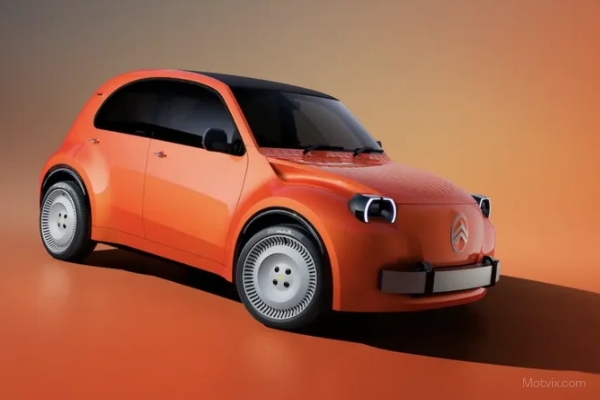
With a length of just 3.76 meters, shorter than the original 2CV — this is a deliberate choice to recapture the pleasure and agility of small cars, whilst making driving and parking easier.
The new 2CV is around 50% lighter than Citroën’s own e-C3 or Honda’s e city car, thanks to a design philosophy that prioritizes lightness above all else. Citroën is targeting a weight of around one tonne, which would help reduce energy consumption and allow for a smaller, less expensive battery.
The exterior reinterprets the original 2CV’s round forms and minimalist approach through a contemporary lens. Large flared wheel arches evoke the original, while the overall surfacing is cleaner and more modern. The concept features fabric door pulls — a nod to the original’s spartan character — and all controls placed on the steering column, keeping the interior as uncluttered as possible. The tubular frame seats can be removed entirely for outdoor use, a detail that captures the original 2CV’s practicality in a contemporary way.
Powertrain: What Is and Isn’t Confirmed
Battery capacity, motor output, range and charging figures have not been disclosed. Citroën has confirmed only that the production model will be fully electric and designed around a weight target of approximately one tonne — a constraint that effectively limits the battery to a smaller, less expensive unit sized for everyday urban use rather than long-distance travel.
The closest rivals are the Renault Twingo Electric at approximately 270 km of WLTP range, and the Dacia Spring at 220 km. The new 2CV will undercut the Twingo on price while matching it on range. Industry estimates suggest approximately 263 km of WLTP range is achievable within the weight and price constraints Citroën has set — enough for most European daily commuting patterns.
It is to be manufactured in Europe, with a target starting price of around €15,000.
Where It Sits in the Citroën Lineup
The car will sit between the Ami quadricycle and the C3 in Citroën’s lineup and be developed in line with new European E-Car regulations. The Ami, Citroën’s micro-mobility vehicle, starts below €10,000 but is not a full car under EU law — it cannot be driven at highway speeds and has very limited range. The C3 electric, meanwhile, starts from approximately €23,300. A 2CV at €15,000 fills a meaningful gap between them.
The production model will comply with the EU’s new E-Car regulations — a framework being developed specifically to enable lighter, simpler, more affordable electric vehicles that do not need to meet the full safety and technology requirements that apply to conventional cars. This regulatory pathway is central to making the €15,000 price target achievable.
What This Means for the Market
The Citroën 2CV Concept is the most emotionally resonant car shown at the 2026 Paris Motor Show — and arguably the most commercially significant. If Citroën can deliver a production version at or near the €15,000 target, it would give European buyers an affordable, European-built alternative at exactly the price point where Chinese competition is strongest. Whether the nostalgia translates into actual purchase decisions will determine whether the 2CV’s revival is a triumph or a tribute. The production reveal, expected in 2027 ahead of the 2028 launch, will answer that question.