Ford has officially unveiled the Fathom — a new electric pickup truck starting at $28,000 that the company has positioned as one of the most important vehicles it has launched in years. Not because of its horsepower or its range, but because of what it represents for Ford’s ability to make money selling electric vehicles.
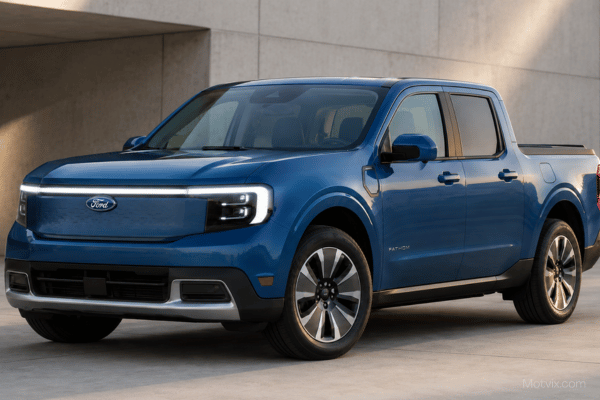
The Fathom is the first vehicle to be built using Ford’s new Universal Electric Vehicle platform — a purpose-built EV architecture that the company says is key to making EVs financially viable at scale. If that claim proves true, the Fathom could be the turning point that Ford’s EV business has been waiting for since it began losing billions of dollars per vehicle on the F-150 Lightning.
The Price That Changes the Conversation
The $28,000 starting price is the most immediately striking thing about the Fathom. For context, the F-150 Lightning — which the Fathom is designed to partially replace at the entry level — launched at $39,974 before quickly moving to higher price points. The Lightning’s cost structure proved impossible to make profitable, and Ford has been transitioning that model toward a hybrid format as a result.
At $28,000, the Fathom enters the market at nearly the same price point as the Ford Maverick hybrid pickup — and well below the threshold that most analysts had assumed was achievable for a new electric truck with genuine utility. It is also the same price that Elon Musk famously promised but never delivered with the original Tesla Model 3.
The key question, which Ford will need to answer with financial results rather than press releases, is whether the company can actually sell the Fathom at that price and generate positive margins.
The Universal Electric Vehicle Platform
The UEV platform is the technical foundation of Ford’s argument. The company developed it specifically to address the cost structure problems that plagued the F-150 Lightning, whose manufacturing costs were so high that Ford was losing an estimated $60,000 or more per vehicle sold at certain points in the Lightning’s production run.
The UEV platform is designed with a modular architecture that reduces the number of unique components required across different vehicle sizes and configurations. By sharing more parts across models, Ford can manufacture at higher volume per component, which drives costs down. The platform also supports both battery electric and range-extended electric powertrains — giving Ford flexibility to configure vehicles differently for different markets without developing separate platforms.
Ford has not disclosed the Fathom’s battery capacity, EPA-rated range, or motor output in the launch announcement. Those details are expected to follow in the coming weeks. Based on the $28,000 price point and the company’s stated goal of affordability, industry analysts expect the Fathom to be positioned as a practical daily-use truck rather than a long-range premium hauler.
Who Is the Fathom For?
The Fathom is aimed at a buyer who wants a pickup truck’s utility and form factor but is not willing — or able — to spend $50,000 or more to get an electric version of it. That is a large and currently underserved part of the market.
The Maverick hybrid has proven that there is strong demand for affordable, compact, truck-shaped vehicles in America. The Fathom takes that concept electric, targeting buyers who do mostly urban and suburban driving, have access to home charging, and want a truck bed without a massive price tag or a dealership negotiation.
It also positions Ford to compete with whatever comes next from Tesla — which has been rumored for years to be developing a smaller, more affordable electric truck below the Cybertruck. If a sub-$30,000 Tesla electric vehicle arrives in the next two years, Ford will already have a product in the segment.
What Ford Said About the Fathom
Ford’s leadership has framed the Fathom explicitly within the company’s strategy of rebuilding its EV business around financial sustainability. After announcing that its EV division lost significant amounts of money in 2024 and 2025, CEO Jim Farley indicated that the next generation of Ford EVs would be held to a strict profitability discipline. The Fathom, built on the UEV platform, is the first real-world test of whether that discipline is paying off.
The company has not announced a production timeline, trim levels beyond the base configuration, or whether additional powertrain options will be offered. Full details, including EPA range, towing capacity, and payload ratings, are expected to follow in the coming months as the Fathom approaches its on-sale date.
What is clear is that Ford needs the Fathom to succeed on two levels simultaneously: it needs to sell well enough to demonstrate consumer demand for affordable electric trucks, and it needs to be profitable enough to prove that the UEV platform actually delivers on its promise. The next chapter of Ford’s EV story starts here.