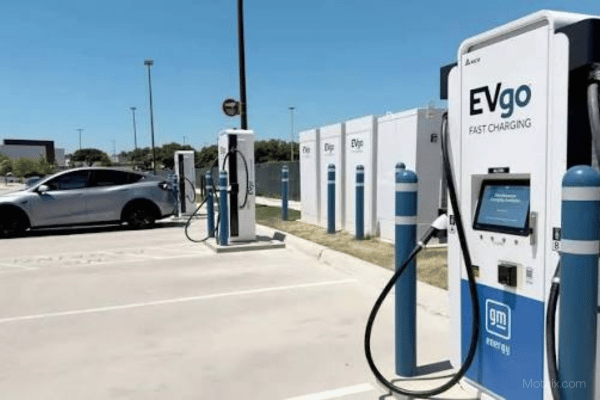
EVgo and Regency Centers plan to add more than 400 fast-charging stalls at grocery-anchored shopping centers across the United States.
The expansion builds on a partnership that began in 2020 and currently includes more than 150 EVgo stalls at Regency properties.
When completed, the new installations are expected to increase Regency’s electric-vehicle charging footprint by more than 20 percent.
The location strategy is as important as the number. Drivers do not want charging to become a separate errand if it can fit into time already spent buying groceries, eating or using local services.
Regency’s centers are typically positioned in metropolitan, high-density areas and anchored by major grocers.
That makes them natural places for charging sessions that last longer than a fuel stop but shorter than an overnight stay.
EVgo says the first group of markets will include locations in Colorado, Florida, Illinois, New Jersey, New York, Pennsylvania, Texas and Virginia, along with other states.
Specific addresses and a completion schedule were not included in the announcement, so the 400-plus figure should be understood as a forward plan rather than stalls already available.
Up to 24 chargers at a site
Each new site developed through the partnership can include as many as 24 high-power chargers.
Larger installations have two advantages: they can serve more drivers during busy periods and reduce the chance that a single broken or occupied charger makes the location unusable.
The final number at each center will depend on parking layout, utility capacity, demand and permitting.
EVgo says the equipment can deliver a full charge in as little as 15 minutes, depending on the vehicle.
That phrase needs context. No charger controls the entire session; the car sets its own power request based on battery size, temperature and state of charge.
Many drivers also stop at 80 percent because charging usually slows as the battery fills.
A 15-minute result therefore applies only to compatible vehicles under favorable conditions and should not be treated as a universal promise.
What matters operationally is that the site can support modern high-power EVs while the driver completes a short retail visit.
EVgo cites an average grocery dwell time of 23 minutes. For a vehicle with an effective charging curve and a warm battery, that period can add substantial range even if it does not reach 100 percent.
Retail and charging can help each other
The partnership reflects a simple economic connection.
A charging driver is a potential customer with time to spend, while a grocery or shopping destination gives the driver a useful reason to choose one charger over another.
EVgo says roughly half of drivers who stop at a charging site enter an adjacent retail or food business, based on research cited in its release.
That relationship can make infrastructure more durable.
Charging operators gain locations with regular traffic and amenities; property owners gain a service that may attract repeat visits. Drivers gain restrooms, food, lighting and activity around the site.
The best installations will also offer accessible spaces, safe pedestrian routes, clear signs and canopies where local conditions justify them.
Poor placement can weaken those benefits.
Chargers hidden behind loading areas, blocked by deliveries or far from an accessible entrance create friction.
Site design should account for cable reach, vehicles towing trailers, wheelchair access and snow removal.
The partnership’s scale gives EVgo and Regency an opportunity to apply consistent lessons across hundreds of stalls.
Grid work is the invisible challenge
Fast-charging construction involves more than installing dispensers.
A site may require new transformers, switchgear, trenching, utility studies and demand-management software. Permits and equipment lead times can vary widely.
That is one reason the announcement does not promise a single completion date.
Multiple high-power chargers can create a large peak electrical load, but intelligent power sharing can distribute available capacity according to each vehicle’s needs.
On-site batteries or solar can play supporting roles in some locations, although neither was specified as a universal feature of this project.
The practical goal is reliable throughput without building more capacity than a site can use.
Maintenance will be equally important. A planned stall has no value until it is energized, and an energized stall must remain easy to activate and capable of delivering meaningful power.
EVgo operates more than 1,200 fast-charging stations across 47 states, giving it a large base of operating data.
Customers will judge the expansion by uptime, payment simplicity and support response rather than the announcement total alone.
Why this expansion is good news
Home charging remains the most convenient option for many EV owners, but it is not available to everyone.
Apartment residents, street parkers, rideshare drivers and travelers depend more heavily on public infrastructure.
Placing fast chargers near routine destinations can reduce the disadvantage for those groups and make an electric vehicle practical for a wider range of households.
The rollout also supports road trips by adding capacity inside metropolitan areas, where drivers begin, end or pause their journeys.
Grocery-anchored centers are usually close to established roads and populated neighborhoods.
They may not replace highway charging plazas, but they complement them with convenient urban and suburban options.
The positive element is not simply 400 additional plugs. It is the decision to integrate charging into ordinary life and to build sites with the potential for multiple simultaneous sessions.
The plan still faces permitting, utility and construction work, and drivers should wait for confirmed locations before changing travel plans.
If EVgo and Regency execute it reliably, however, the partnership can turn a weekly shopping stop into useful driving range—and make public charging feel less like special infrastructure and more like a normal neighborhood service.