Hyundai has officially launched the new Ioniq V in China, introducing an aggressively priced electric vehicle designed specifically to strengthen the Korean automaker’s position in the world’s largest EV market.
Beijing Hyundai launched the model on September 29, 2026, offering five versions with official prices ranging from 109,900 yuan to 139,900 yuan.
For a limited period, promotional pricing starts at 99,900 yuan, making the Ioniq V a particularly interesting competitor in China’s crowded electric vehicle segment.
The vehicle combines distinctive styling, up to 650 kilometers of claimed CLTC range and a surprisingly competitive price.
Hyundai Developed the Ioniq V for China
The Ioniq V is an important vehicle for Hyundai because it represents a new approach to the Chinese market.
Rather than adapting an existing global model, Hyundai developed the vehicle with significant involvement from its China-based design and engineering teams.
Hyundai officially introduced the Ioniq V during the Beijing Auto Show earlier in 2026 as the first step in a much broader product offensive.
The automaker plans to introduce 20 new models in China over the next five years, including battery-electric vehicles and extended-range electric vehicles.
Hyundai describes this strategy as “In China, For China, To Global.”
In practice, that means vehicles and technologies developed for the highly competitive Chinese market could eventually influence Hyundai products sold internationally.
Up to 650 KM of Electric Range
Customers can choose between two battery configurations.
Entry-level versions use a 53.48-kWh battery, while long-range models receive a larger 66.85-kWh battery pack.
The smaller battery provides a claimed 540 kilometers of CLTC range.
Long-range versions increase that number to 650 kilometers under the CLTC cycle.
As always, CLTC figures should not be directly compared with EPA range ratings in the United States.
The Chinese test cycle typically generates higher figures than EPA or WLTP testing.
Actual range will vary depending on driving style, weather, speed, climate-control use and other conditions.
Still, 650 km is a competitive specification for an EV positioned at this price.
Two Electric Motor Options
Hyundai is offering two different power outputs.
Some versions use a single electric motor producing 140 kW, or approximately 188 horsepower.
Higher-spec versions increase output to 168 kW, equivalent to approximately 225 horsepower.
Both configurations focus more on efficiency and everyday usability than extreme performance.
This reflects the Ioniq V’s positioning as a practical mid-size electric vehicle rather than a high-performance EV.
The vehicle also uses a relatively long 2,900-mm wheelbase, which should help provide generous passenger space.
Its overall length is approximately 4,900 mm.
A Very Different Hyundai Design
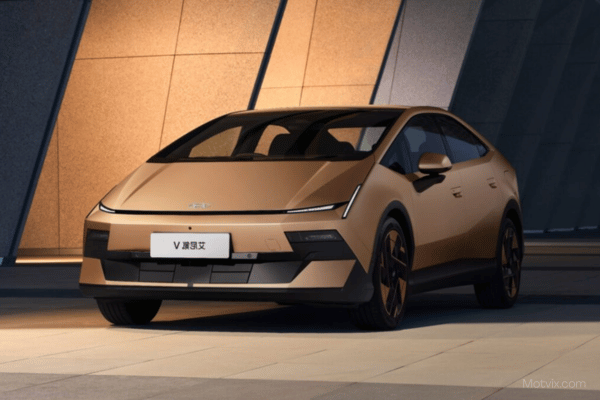
The Ioniq V looks noticeably different from many of Hyundai’s existing electric vehicles.
The front uses a fully enclosed design without a conventional grille.
A slim daytime-running light stretches across the upper portion of the fascia, while the main headlights are positioned lower in the bumper.
The overall appearance is angular and futuristic.
Hyundai says the design was led by its China design operation rather than simply adapting the styling of an existing global Ioniq vehicle.
That decision is particularly important in China, where automakers launch new EVs at an extremely rapid pace.
Standing out visually has become another way manufacturers attempt to differentiate their products.
Practicality Was Also a Priority
Despite its unusual styling, the Ioniq V has been designed around everyday usability.
The cabin includes numerous storage areas.
According to Chinese launch information, Hyundai designed approximately 26 storage spaces throughout the interior.
The center console includes a large open storage area, while the rear cargo area provides approximately 465 liters of space in its standard configuration.
This helps position the Ioniq V as a practical family vehicle rather than simply an EV focused on technology.
Hyundai Faces Tough Competition
Launching an electric vehicle in China is not easy.
The market includes powerful domestic manufacturers such as BYD, Geely, Changan, Xpeng and Leapmotor.
Many Chinese manufacturers offer sophisticated EV technology at prices that traditional global automakers have struggled to match.
That helps explain Hyundai’s unusually aggressive pricing.
The Ioniq V competes with vehicles such as the BYD Seal 06 EV and other similarly priced electric sedans.
Instead of relying solely on brand recognition, Hyundai is competing on range, equipment and price.
Price Could Be Its Biggest Weapon
The official starting price of 109,900 yuan is already competitive.
However, the limited-time promotional price of 99,900 yuan makes the entry version particularly notable.
That converts to roughly the mid-$14,000 range depending on exchange rates.
Pricing varies significantly between markets, taxes and local incentives, so this figure should not be interpreted as an expected U.S. or European price.
There is also no confirmation that the exact China-market Ioniq V will be sold in those regions.
Nevertheless, the pricing demonstrates just how competitive China’s EV market has become.
Hyundai Wants to Rebuild Its Position in China
Hyundai was once a much stronger player in the Chinese automotive market.
The rapid expansion of domestic electric vehicle manufacturers dramatically changed that landscape.
Now Hyundai is attempting to rebuild its position with vehicles developed specifically for local buyers.
The company has committed to significant investments in Beijing Hyundai and sees China not only as a sales market but also as an important development center for future technologies.
The Ioniq V is the first major test of that strategy.
An Important EV for Hyundai
On paper, the Hyundai Ioniq V combines several elements Chinese EV customers increasingly expect.
It offers up to 650 km of claimed range, modern technology, a spacious interior and aggressive pricing.
Perhaps more importantly, it shows that Hyundai is willing to design vehicles specifically for China rather than simply bringing existing international models into the country.
Whether the Ioniq V can compete successfully against established Chinese EV brands remains to be seen.
But with a promotional entry price below 100,000 yuan and up to 650 km of CLTC range, Hyundai is clearly entering the fight with a much more aggressive strategy.