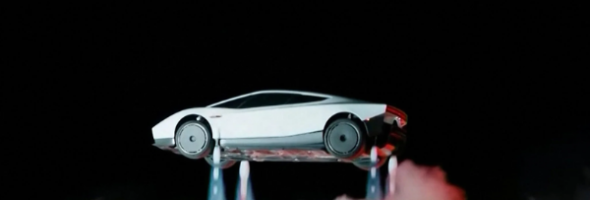
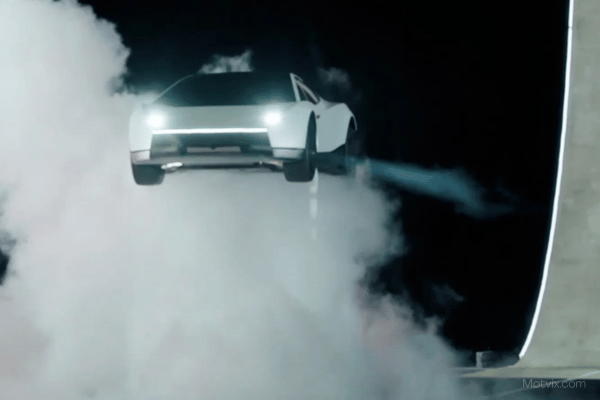
After nine years of delays, the Tesla Roadster finally arrived. Tesla revealed its redesigned second-generation Roadster with SpaceX thrusters at an event outside Waco, Texas, with a demonstration that saw the car use a mixture of high-powered fans and thrusters to drive up an inverted ramp, spin around, and ease itself to a landing on the pavement below. The car also used the thrusters to lift itself over a Cybercab, Cybertruck, Tesla Semi, Model Y, and Model 3 while in motion.
CEO Elon Musk called it “the best of the last of the human-driven cars.” Whatever one thinks of that framing, the numbers and the demonstration were impossible to dismiss.
Three Configurations, Three Levels of Ambition
The Roadster comes in three versions. The Performance version is road ready and seats two, with active aerodynamics and a multi-mode suction system, with 0-60 mph in under 1.6 seconds. The Thrust version is race ready, also seats two, and adds rear-mounted cold gas thrusters for a 0-60 time of under 0.9 seconds. The Rocket is a single-seater designed to fly, with cold-gas thrusters placed around the car’s perimeter for forward, upward and rotational movement, with 0-60 mph in under 0.59 seconds.
That last number — under 0.59 seconds to 60 mph — is not a typo. Tesla confirmed the official 0-60 mph figure for the base Roadster at 0.81 seconds, cementing its status as the quickest production car in the world. Elon Musk added that the Thrust variant’s cold-gas thrusters generate 4.6 Gs of acceleration during its 0-60 mph run — more than 2.7 times the G-force experienced by a pilot during an F-18 catapult launch from an aircraft carrier.
All three versions offer 230+ mph top speed and 300+ miles of range.
How the Thrusters Actually Work
The cold-gas thruster system is the most technically unusual element of the Roadster — and the one that makes the Rocket configuration what it is. The thrusters use compressed air rather than rocket fuel. Tesla uses two ultra-high-pressure tanks with a combined volume of 600 liters holding about 250 kilograms of air, released through 10 nozzles, with all-electric actuators making micro adjustments to stabilize the car in flight.
A multi-mode fan and ground sealing system pulls air from under the car, producing enough suction to hold it upside down even when stationary. That suction system — which generates downforce by creating a low-pressure zone under the vehicle — is not just for the ramp stunt. In the Performance and Thrust versions, it also functions as an active downforce generator at high speeds, supplementing the aerodynamic grip that tires alone cannot provide at the kind of cornering forces these acceleration numbers imply.
Tesla’s Roadster comes with steer-by-wire and a yoke-style steering control. Charging from 15 to 80 percent is targeted at approximately 10 minutes, though that figure has not been independently verified.
Nine Years, and It Was Worth Waiting For
It’s the latest date in a long list of them. Tesla first revealed the car in 2017 with deliveries promised for 2020. Six years later than promised, the vehicle that arrived in Waco, Texas on October 15 is genuinely unlike anything else on the road — or above it.
A redesigned two-seat version was shown in October 2026, with production planned for 2028. Tesla announced three configurations — Performance, Thrust, and Rocket — the latter two using cold-gas thrusters developed with SpaceX.
Reservation holders who placed $50,000 deposits years ago still do not have a delivery date. Production is guided for 2028. But the demonstration in Waco answered the question that has been open since 2017: is this car real? The answer, after nine years, is yes.
What This Means for the Industry
The Roadster is not a mass-market vehicle. At a $200,000 base price for the Performance, with the Thrust requiring a $250,000 deposit and the Rocket being invitation-only, it occupies an extreme niche. But its engineering implications extend further.
A production road car that can physically lift off the ground — even briefly, even with compressed air rather than rocket propellant — represents a category that did not exist before October 15, 2026. How regulators handle approval for such a vehicle, how insurers price it, and whether other manufacturers pursue similar technology will unfold over the next several years. Tesla has not just built a fast car. It has created a new category of vehicle entirely.