Researchers at Germany’s Fraunhofer Institute for Solar Energy Systems ISE have developed a battery-cell architecture capable of storing between 10% and 15% more energy without increasing cell weight.
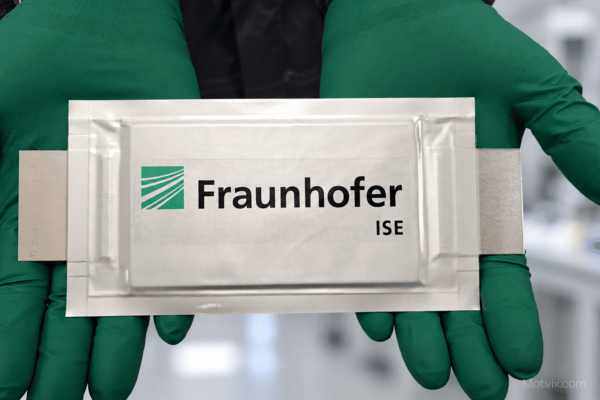
The approach does not depend on a completely new battery chemistry. Instead, researchers redesigned the internal structure of the cell by producing substantially thicker electrodes and reducing the number of current collectors required inside it.
Although the research initially focused primarily on stationary energy storage, Fraunhofer ISE says the underlying principles could also be transferred to electric-vehicle traction batteries.
How Thicker Electrodes Store More Energy
A conventional battery cell contains multiple alternating layers of electrode coating and metallic current collectors.
The electrode coating contains the active material responsible for storing energy. Current collectors conduct electricity between that material and the battery’s external connections, but they do not directly contribute to energy storage.
Most conventional electrode coatings are approximately 100 to 200 micrometers thick. Fraunhofer ISE increased that measurement to as much as 800 micrometers.
Because each electrode contains more active material, manufacturers can use fewer individual layers and fewer current collectors. That leaves a greater proportion of the cell’s total weight and internal volume available for energy-storing material.
Depending on the chemistry and cell design, researchers measured an energy-density improvement of between 10% and 15%.
Tested in Lithium-Ion Pouch Cells
The team first tested the architecture in small laboratory cells using lithium-ion, sodium-ion and zinc-ion chemistries.
Fraunhofer ISE then produced lithium-ion pouch-cell prototypes on a semi-automated manufacturing line using processes designed to resemble industrial battery production. This step is significant because laboratory discoveries often become difficult to reproduce when cell size and manufacturing volume increase.
The researchers say the design could also be adapted to other battery chemistries. That flexibility may allow manufacturers to use the concept without becoming dependent on one specific combination of cathode and anode materials.
The electrodes are also PFAS-free and can be manufactured without toxic solvents, according to the institute.
What It Could Mean for Electric Vehicles
Higher gravimetric energy density—the amount of energy stored for a given weight—is one of the most important targets in electric-vehicle battery development.
If adapted successfully for automotive use, the thicker-electrode architecture could allow an EV battery pack to store more energy without becoming heavier. Automakers could potentially use that improvement to increase driving range or install a smaller pack while preserving the vehicle’s existing range.
A lighter or more compact battery pack could also benefit efficiency, handling, interior packaging and material consumption.
However, a 15% increase in cell-level energy density should not automatically be interpreted as a 15% increase in vehicle range. A complete battery pack includes cooling systems, structural protection, electronics, wiring and other components that are unaffected by the electrode redesign.
Vehicle efficiency, climate conditions and driving speed would also continue to influence real-world range.
Manufacturing Could Become Simpler
Fraunhofer ISE says the proposed production process could be less complex than conventional wet electrode coating.
Using fewer internal layers could reduce the amount of equipment, production space and energy required to manufacture cells. That could lower capital and operating costs if the process is successfully industrialized.
The work was supported by several German government-funded research projects, including VORAN, which covers sodium-ion batteries for stationary and mobile applications, and the INFAB and WinZIB2 zinc-ion battery programs.
Industrial partners are also helping develop the necessary electrode-manufacturing equipment.
Promising, but Not Production-Ready
The technology remains at the prototype stage. Fraunhofer ISE describes the results as a promising path toward industrialization rather than a battery product ready for immediate vehicle production.
Thick electrodes can introduce challenges involving charging speed, heat distribution and the movement of ions through the active material. These factors will need to be evaluated through larger cells, repeated fast-charging tests and extended durability studies.
Even with those limitations, the project demonstrates that meaningful battery improvements may come from changing cell architecture—not only from discovering new materials.