Volkswagen is preparing a major 2027 update for its IQ.DRIVE assistance suite, bringing new lane-change functions, a more capable emergency response and richer map-based support to vehicles built on its MQB Evo and MEB platforms.
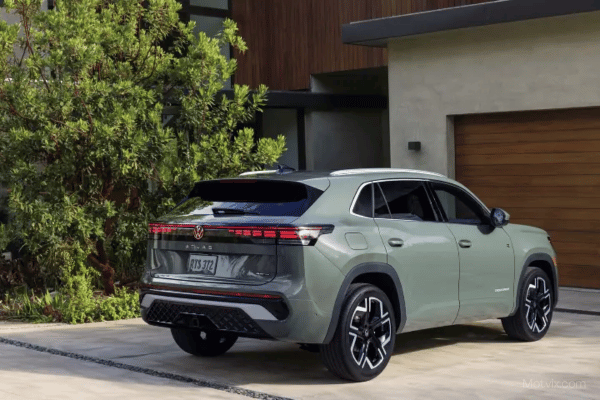
The package is expected to reach models including the Atlas, Golf, Tiguan and electric ID. Buzz, although exact equipment and availability may vary by market and trim.
The update is encouraging because it concentrates on situations drivers regularly face: changing lanes on a busy highway, responding when a person becomes unresponsive and adjusting speed around exits or road features.
None of these functions makes the vehicle autonomous. Volkswagen explicitly requires an attentive driver, and the person behind the wheel remains responsible for observing traffic and taking control.
That distinction is important. Advanced driver-assistance systems are most useful when their limits are as clear as their capabilities.
Describing them accurately can prevent overconfidence while still recognizing the safety and comfort benefits of well-designed support.
A driver-initiated lane change
The upgraded Travel Assist can help complete a lane change above 45 mph after the driver activates the turn signal.
Rear radar sensors check the adjacent lane, and the system waits for a suitable opening before guiding the vehicle across. If the opportunity does not appear immediately, it can continue looking for up to twelve seconds.
The driver still has to monitor mirrors, blind spots and surrounding traffic. Sensors can be affected by rain, snow, dirt, road geometry or fast-approaching vehicles.
The benefit is not permission to stop paying attention; it is reduced workload during a maneuver that combines steering, speed control and traffic assessment.
For a long motorway journey, small reductions in workload can matter. Travel Assist already combines adaptive cruise control with lane centering.
Adding a supervised lane-change function makes that assistance more continuous, particularly when passing slower traffic.
The quality of the handoff is critical: the interface should make it obvious when the system is ready, when it is acting and when the driver must intervene.
Emergency Assist Plus responds to silence
The most important safety addition may be Emergency Assist Plus.
If the vehicle detects no steering input for approximately 25 seconds and the driver does not respond to escalating warnings, the system can begin a controlled intervention.
Depending on traffic and road conditions, it is designed to move toward the shoulder or the farthest-right available lane, stop, activate hazard lights, sound the horn, unlock the doors and place an emergency call.
Such a sequence could help after a medical emergency, when simply slowing to a halt in a travel lane may expose the occupants and other road users to additional danger.
Moving aside and making the car easier for responders to access addresses the problem as a chain of events rather than a single braking action.
Real roads are unpredictable, so the system cannot guarantee a perfect outcome.
Construction zones, missing shoulders, poor lane markings or dense traffic may restrict what it can do.
The driver-monitoring logic also has to distinguish genuine unresponsiveness from unusual but harmless behavior. Still, the goal is constructive: if the person in control can no longer act, the vehicle should try to reduce risk and call for help.
Predictive cruise control gains context
Predictive adaptive cruise control, or pACC, uses route and map information to adjust speed around features such as exits and ramps.
A smoother early reduction can feel more natural than waiting until the last moment, and it may improve efficiency by avoiding unnecessary acceleration and braking.
Map-based systems need current, accurate data. Temporary speed limits and construction can differ from the stored map, while signs may be obscured.
The driver therefore remains the final authority. The strongest implementation will combine map context with camera recognition and make it easy for the driver to override an inappropriate adjustment.
In the ID. Buzz, Volkswagen also plans a Road Experience Management feature that draws on cloud data for information about lane markings, signs, lighting and speed context.
The vehicle will include a one-year trial of the required Premium subscription in applicable markets.
Buyers should check what remains available after the trial, how much the subscription costs and which functions continue without it.
The value of a standard safety foundation
Volkswagen says the core IQ.DRIVE suite includes Travel Assist, Front Assist, Active Blind Spot Monitor, Rear Traffic Alert, adaptive cruise control, Lane Assist and Emergency Assist.
A broad standard package can improve safety across the fleet rather than restricting the most useful tools to luxury versions.
Consistency also helps drivers. When controls and warnings behave similarly across Golf, Tiguan, Atlas and ID. Buzz, a household or fleet moving between models has less to relearn.
Clear naming remains important because the industry often uses similar labels for systems with different limits. An owner should be able to understand the feature without studying marketing vocabulary.
Training at delivery can make a major difference.
A short demonstration of activation, cancellation, sensor limitations and warning stages may prevent misuse.
Dealers and digital owner manuals should show not only what each function can do, but also the conditions under which it may disengage.
A measured step toward safer travel
The 2027 update is not a leap to self-driving capability, and that is precisely why it can be useful.
It improves supervised assistance around specific, frequent tasks and adds a thoughtful response to driver incapacity.
The ID. Buzz’s cloud-based road context also shows how connected data can supplement onboard sensors without replacing them.
Independent testing will determine how smoothly the lane changes work, how often the system produces unnecessary warnings and how robustly Emergency Assist behaves in complex traffic.
Regional regulations may alter the feature set as well. Subject to those caveats, Volkswagen is making IQ.DRIVE more practical rather than simply more impressive on paper.
For drivers, the positive outcome is a vehicle that can share some routine workload and offer another layer of protection in an emergency.
The technology is at its best when it supports human judgment, communicates honestly and encourages attention. Volkswagen’s new package appears designed around that principle.